Showing posts with label Fishertown. Show all posts

Monday, September 12, 2016

Jonah Harbaugh and Elizabeth Callihan Harbaugh


Jonah and Elizabeth are two of my ancestors who leave me with many more questions than answers. I do know that death and heartache were profound elements of Elizabeth's life.

Jonah had a twin brother named after their father, John. His mother, Rachel, was a Quaker.  I don't know exactly how involved Jonah was with the local Quaker congregation, but his body was buried in the Quaker cemetery near Fishertown in Bedford County.  

Elizabeth was the 4th oldest of 14 children. She was an active member of the Dunkard church. In her later years she enjoyed bringing her grandchildren to church with her.

Jonah and Elizabeth were married sometime before 1840. Their son, George, was born probably around 1841 or 1842. On 4 July 1843, Jonah died, making Elizabeth a very young widow and single mother.  The first of many tragedies in her life.


To complicate things even more, their daughter (my 2nd great-grandmother), Elizabeth Ellen, was born exactly 2 months following Jonah's death. A little less than 2 years later, Elizabeth's mother died.  Think about that - as a very young widow raising 2 small children on her own, Elizabeth lost her mother. 


As I try to put myself within the culture of the day, I would think that extended family was just kind of a given and was, I guess, completely ubiquitous. Almost everyone, it seems, was within spitting distance of extended family members of some type or another.  That's not to say that those closest to you are somehow diminished or less important by any means, but at least there was always some type of back-up plan should ultimate tragedy occur.  This had to provide some kind of comfort and support.  At least, I would like to think so.

If you remember from previous posts, Elizabeth's mother was a Reininger and had married a Callihan. The Callihan and Reininger farms were adjacent to each other. 


As the families grew and the farms expanded, additional homes and dwellings would be built within close proximity to each other.  US census records can help tell the story and put some of the pieces together.  The 1840 census shows Jonah Harbaugh and his wife living among the Callihans and the Reiningers.


It was during the 1840s when Elizabeth lost her husband.  By 1850 she and her children were living apart. Elizabeth was living with her Uncle George Reininger and Aunt Susan in a house on the Reininger farm.  Aunt Susan was a Harbaugh, though I don't know if or how she was related to Elizabeth's deceased husband, Jonah. Also living in the house was Elizabeth's younger sister, Sarah, who was only 2 yrs. old when their mother died, as well as a young farm hand.


Elizabeth's 2 children, George and Ellen, were living with Jonah's parents, John and Rachel Harbaugh.  I don't know why Elizabeth didn't have her children living with her, I don't know how far away her parents were (though it wouldn't have been more than a few miles), and I don't know how often she saw them. I just hope this was an arrangement that was, for whatever reason, good for everyone.


By 1860 Elizabeth was living next to her brother George and his family.  Her daughter Ellen is living with her.  (The census taker didn't get their last names quite right, but no doubt this is Elizabeth and her daughter.)


By 1860 son George would be in his very early 20s.  There's a George W. Harbaugh listed in an 1860 census in Frederick, MD with some other Harbaughs from Pennsylvania.  He's working as a farmer. I'm not convinced at all that this is Elizabeth's son, so I'm not exactly sure where he was in 1860. 

I do know the 1860s were a very eventful and tumultuous time.  The 12th of April 1861 brought the beginning of Civil War. We don't know the exact date, but at some point in the early 1860s Elizabeth's son, George, enlisted in the Union Army. In December of 1863, her daughter Ellen married Adam Ickes. She was probably already pregnant on her wedding day.

On the 11th of July 1864 Elizabeth's son George died from wounds he had received in battle at Petersburg, VA on 16th of June. He was buried at Hampton National Cemetery, Hampton, VA. 

Just 7 days following her son's death (but probably prior to her being notified that her son had died), her first grandchild was born.  John Elmer Ickes, son of Ellen and Adam, arrived in the world on 18 July 1864.

But as the war between the states continued it further affected the family.  In October of 1864 son-in-law Adam enlists as a substitute in the Union Army.  Thankfully, on 6 July 1865  Adam is honorably discharged from service and returns home sometime afterward.

At some point during the 1860s Elizabeth marries a man with the last name of Smith. The marriage is somewhat short-lived as either Mr. Smith dies (which is most likely) or something else happens to dissolve the marriage.  We believe this to be the case because by 1870, as shown in the census, Elizabeth is living with her daughter Ellen and family in Pleasantville. 


Elizabeth was living with Ellen's family when Ellen gave birth to a son, Sheldon Ross, in Jan of 1871, who died less than 3 months later.  She was also there when Ellen gave birth to a son, Henry Beecher, in March of 1872, who died when he was just 2 days old.

The 1880 census shows Elizabeth still living with daughter Ellen and family in Pleasantville.


That's the last known record of Elizabeth Callihan Harbaugh Smith.  There is simply no record of her to be found after 1880.

In 1884 Adam moved his family to Nebraska.  I know from what Adam's daughter Allegra (Aunt Alle) recorded as well as documented evidence from Nebraska State census records that Elizabeth did not go to Nebraska with them.  

Elizabeth and Ellen didn't have a mother-daughter relationship in which the daughter cut the apron strings and pursued a life of her own away from everything parental.  These women's lives were closely intertwined through birth and death and war and uncertainty and heartache and loss. I can't imagine, after all that Ellen and Elizabeth had been through together, that Ellen would ever consider moving a lifetime away and not taking her mother with her if she were still alive.  Elizabeth must have died after 1880 and prior to 1884.  I just can't believe anything else.  But I really wish I knew for sure.


All original content, images, commentary, etc. copyright © by Joy Denison 2015-2016.  All rights reserved. All writings, poems, speeches, essays, images, scans, likenesses, etc. by Adam Ickes (b 1845) as well as personal histories, images, and all other content by all persons referenced and discussed within the pages and posts in this blog may not be copied, shared, or reproduced in any way without expressed permission by the owner unless included here from other referenced sources or are historical records already considered to be in the public domain. 

Tuesday, September 6, 2016

The Abolitionists

I actually don't have any ancestors in my direct line who are listed in the history books among the Bedford County abolitionists, but my ancestors were immediate family members and associates of those who aided the underground railroad.  I can't help but highlight the efforts of the Bedford County residents in this noble and selfless cause.

The Underground Railroad was a clandestine network of routes and safe houses ferrying escaped slaves from the South to Canada.  It began operating in Bedford County in 1835.  Bedford County was directly north of the Mason-Dixon line, so escaped slaves who would take the route through Bedford County would find themselves in free territory as soon as they crossed the border into Pennsylvania.  Once fugatives left the vicinity of the borough of Bedford the most popular route to follow took them through the Quaker community of Fishertown.


According to the history books, among the Fishertown residents providing assistance to runaway slaves was Nathan Hammond, more than likely the son or grandson on my 5th great-grandfather Nathan Hammond.  His son, Nathan, died in 1860 and was probably too old to be involved with the abolitionists.  He had more than one grandson named Nathan, so without a ton of research I don't know for sure which Nathan it would be.  According to the 1861 map, a N. Hammond estate was located atop a large hill accessed by what is now called Hammond Hill Road leading northeast from Fishertown.


When we visited there the expansive views were spectacular.


A plaque at the Quaker Burial Ground near Fishertown pays tribute to those who assisted the effort to help escaped slaves secure their freedom.


From Fishertown, runaways were often directed to Pleasantville (Alum Bank), assisted sometimes by George Harbaugh, brother of my 3rd great-grandfather, Jonah Harbaugh, to the home of Benjamin Walker where they would receive aid to travel further north.

Many others residents and land owners assisted and played vital roles in assisting the Underground Railroad in Bedford County, and several stories were preserved and retold.  Not everyone, though, shared in the great cause.  A story is told of two men, each from prominent families - the Mocks and the Crissmans - who sought only for their own personal gain:
"It was a short time prior to the Civil War when two slaves found their way into the so-called Quaker settlement, with the evident hope of procuring assistance in their journey northward. Somewhere in the vicinity named they met two men by name of Mock and Crissman, who, it seems, knew of a reward being offered for the capture of a certain two slaves, and who, under the pretense of being friendly to their interests, induced the negroes to be locked-up in an old school-house nearby, while arrangements would be made for their conveyance to some northward station. The captors at once went to Bedford and got into communication with their master, who promptly came on, identified his property, paid the prize money and returned home with his possession of human souls.
"This was one of the few instances, if not the only one, of like character which occurred in the neighborhood of the underground railway people of this section.
"To the sore disappointment of the poor slaves, we can well imagine, there would be added the oppression and vengeance of a tyrannical master when back on the old plantation.  On the other hand, to the treachery and deception of the captors there was added the contempt and reproach of every good citizen in which they lived. Neither of them prospered after this event. Mr. Mock soon afterward came to an untimely death by being shot at Alum Bank while attempting to escape from the custody of a squad of soldiers who had been detailed to preserve order at an election at St. Clair township, and who had him under arrest for disturbing the peace. Numerous afflictions and misfortunes followed Mr. Crissman during the several years which he lived afterward, and whilst he, no doubt, regretted his conduct and would have undone the deed if such were possible, he never regained the confidence or respect of the people." (History of Bedford and Somerset Counties, Pennsylvania, Vol. 1, pgs. 381-382)

The account also indicates that the school-house in which the escaped slaves were imprisoned was located on the road leading from Osterburg about one-half mile from Alum Bank on the Rinninger farm.  That would be the exact location of the farm which was then occupied by the son of my 5th great-grandfather, George Reininger.  There is no indication whatsoever that any member of the Reininger family benefited or assisted in any way in the imprisonment of the two runaway slaves.


Old Schoolhouse near Alum Bank, Where Two Runaway Slaves Were
Penned Up and Held for Ransom

NEXT POST

PREVIOUS POST

All original content, images, commentary, etc. copyright © by Joy Denison 2015-2016.  All rights reserved. All writings, poems, speeches, essays, images, scans, likenesses, etc. by Adam Ickes (b 1845) as well as personal histories, images, and all other content by all persons referenced and discussed within the pages and posts in this blog may not be copied, shared, or reproduced in any way without expressed permission by the owner unless included here from other referenced sources or are historical records already considered to be in the public domain. 

Sunday, June 19, 2016

Thomas Callihan - One More piece of History

If you remember, Thomas Callihan deserted on Apr 5, 1778 after leaving Valley Forge and marching to New Jersey, more specifically Haddonfield, per orders from George Washington.  His commanding officer was Colonel Israel Shreve.   Based on others in his regiment being taken prisoner on that day, I speculated that Thomas deserted because of a raid by the British. A quick google search for "2nd New Jersey Regiment Revolutionary War" turned this up on Wikipedia and several other sources:

"Through the spring of 1778, on detached duty and in cooperation with the Jersey Militia, the 2nd New Jersey gathered forage and supplies, and skirmished with the British and Loyalists for two months."

April 5th was, in fact, an important day in the history of the 2nd New Jersey.  The account continues:

"On 4 and 5 April 1778, British forces repulsed Major Richard Howell and his troops from Billingsport, New Jersey. British troops attacked Swedesboro and marched on towards Haddonfield. Col. Israel Shreve evacuated from Haddonfield about 2 am Sunday morning, 5 April, and speed marched his troops to Mount Holly. Haddonfield was attacked, two Quaker houses were burned, and American rider Miles Sage was stabbed multiple times by British (but survived). British troops proceeded to Cooper's Ferry (present site of the New Jersey access of the Benjamin Franklin Bridge). A pitched battle ensued, with about 50 American troops (most of whom were part of Shreve's Regiment),led by Major William Ellis (Gloucester Militia). Orders had been given by Shreve (and sent by Miles Sage) to vacate upon the ignition of an alarm cannon. The cannon was never fired, and Ellis refused to retreat across the Cooper Creek Bridge. Many men were wounded, killed or captured. The British were furious about the lost opportunity to capture Shreve at Haddonfield but elated about the capture of the American picket at Cooper's Ferry (including a set of spy glasses given by Washington to spy upon the Philadelphia shore). Washington was furious at Shreve and never forgave him."

The Haddonfield skirmish of April 5, 1778 was recently reenacted.


NEXT POST

PREVIOUS POST

All original content, images, commentary, etc. copyright © by Joy Denison 2015-2016.  All rights reserved. All writings, poems, speeches, essays, images, scans, likenesses, etc. by Adam Ickes (b 1845) as well as personal histories, images, and all other content by all persons referenced and discussed within the pages and posts in this blog may not be copied, shared, or reproduced in any way without expressed permission by the owner unless included here from other referenced sources or are historical records already considered to be in the public domain. 

Friday, June 17, 2016

Thomas Callihan Rewrite

I sent a link to my Thomas and Mary Callihan post to Robert Callihan who forwarded it on to Don Callihan.  Both are founders, researchers, and major contributors to callihanfamilyresearch.org.  And they're both really nice guys.

I heard back.  It turns out I was just a tiny bit wrong.

Two things.  Three, actually.

First, Don told me there's no evidence Thomas was born in Ireland.  He could have been born in New Jersey for all we know! Well, if that's true, how come callihanfamilyresearch.org has him born in Northern Ireland?

screenshot from callihanfamily research.org

I knew I had seen that somewhere!  Maybe someone else in their research group came to that conclusion and it ended up on the website. But whatever. Apparently, documented evidence is lacking and we may never know for sure.

Second, Don told me the Callihans weren't Quakers.

Well. . . he got me there.

Since virtually ALL of my other Bedford County Irish immigrants were Quakers, and Thomas' first Bedford County land purchase was right smack in the middle of Quaker Central (aka Fishertown), and some of the Callihans married Quakers, I apparently made an incorrect assumption.

Don speculated that they may have been Presbyterian or Methodist.  Actually, not being affiliated with such a tight-knit religious group as were the Quakers could explain the affiliation at least some of them had with the Old Mock Church outside of Pleasantville.  Thomas' son, Robert, was listed in a church record as being one of its trustees.  And he and his wife are buried there.  And my great-grandfather wrote about walking there with his grandmother to go to church.

So definitely not Quakers.

The last item concerned Thomas' service in the Revolutionary War.  Did he serve or didn't he? I guess it could still be up for debate, but Don is convinced. He served.  And deserted.  After a little research of my own, and now that I know more than I did before, I would have to agree with him. And actually, the story is quite fascinating.

On Monday, 20 January 1806, Thomas put an ad in the Bedford Gazette.


photo found at callihanfamilyresearch.org

What do we learn from this?  We know he had a brother named Jacob and a sister named Nancy. They were both living in Morris County New Jersey in 1778. It appears that Thomas had been living there as well, but left in 1778 and had not had any contact with them for 28 years.  He was also letting them know he had relocated to Bedford County Pennsylvania because they would otherwise have no way knowing that.

So what was going on in 1778 that would draw Thomas away from his New Jersey family and not return?  Well, when the places and the dates match up and there are no records that could point to anyone else by the same name, the evidence becomes pretty convincing. 

According to Don, The Thomas "Callehen" or "Kallehan" listed in the records of the New Jersey 2nd Regiment was, in fact, OUR Thomas Callihan.

So he really could have been born in New Jersey???

Well, I found this myself, so. . . .


maybe.  (Actually, with no dates assigned to this record other than a time span of 271 years, this tells us absolutely nothing.  It's like it's totally compelling and completely useless all at the same time! And what's really fascinating is that as long as we don't know, it's exactly like that thing that happened with Schrodinger's cat. And that, my friends, is where science and genealogy come together.)

Back to Thomas.  The available online records and the history books paint a pretty good picture as to where he was and what he was up against.


These two reproduced military records show that Thomas "Callehen" had enlisted as a Continental soldier on January 1, 1778 with the 2nd New Jersey Regiment. It was a part of George Washington's "Grand Army". He was 20 years old.

Thomas probably experienced tearful goodbyes as he left his family members and began marching along side any other new recruits to the place the 2nd New Jersey Regiment had been ordered to spend the winter.  It was only about 80 miles from Morris County, NJ, but from what Thomas left behind it was probably a whole world away. I don't believe anything could have prepared him for what lie ahead. So where was the 2nd New Jersey Regiment in January of 1778?

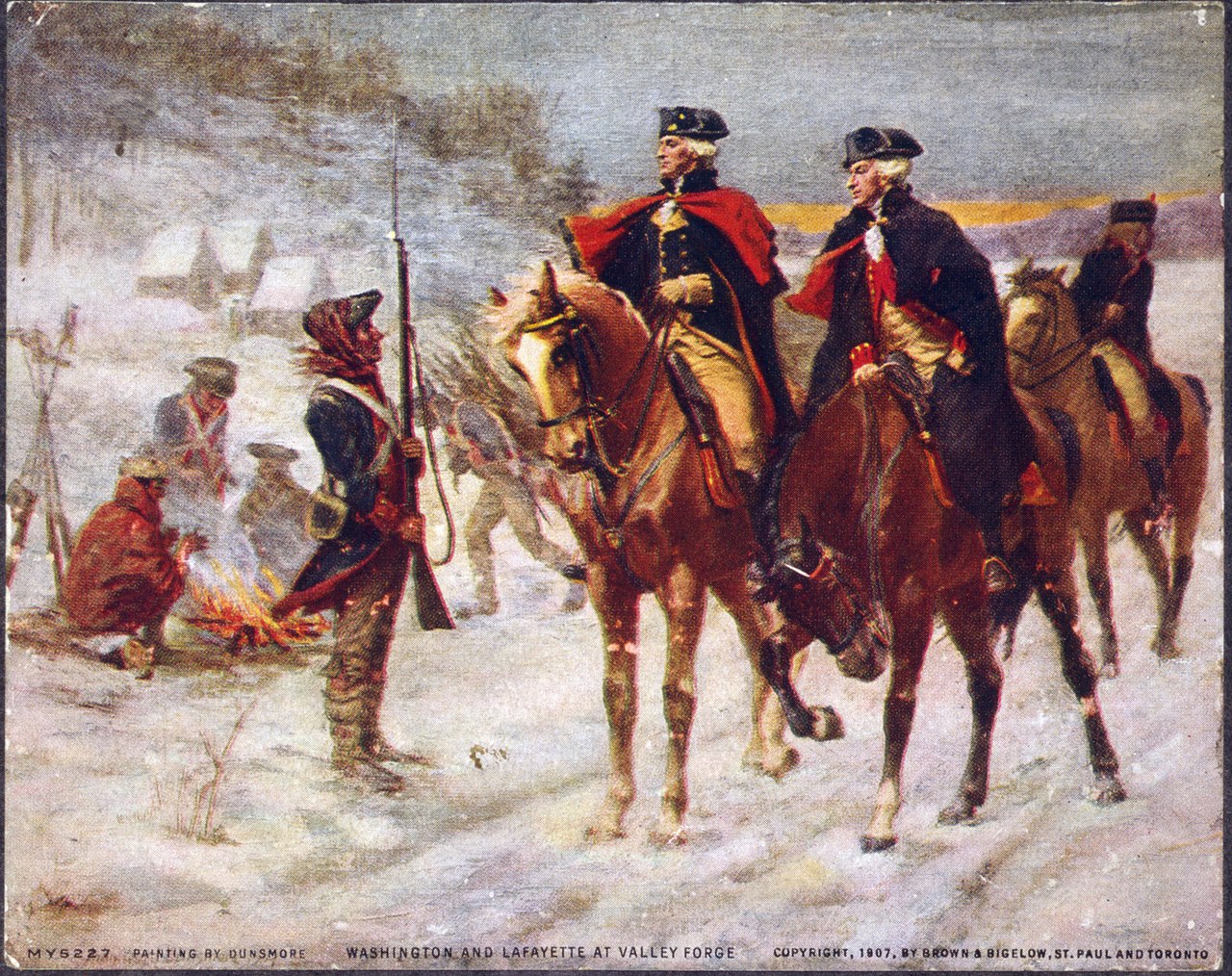
 Valley Forge.

If you forgot your American History (like I did) let me fill you in.  Wikipedia puts it this way:

"Valley Forge was the military camp in southeastern Pennsylvania, approximately 20 miles (30 km) northwest of Philadelphia, where the American Continental Army spent the winter of 1777–78 during the American Revolutionary War. Starvation, disease, malnutrition, and exposure killed over 2,500 American soldiers by the end of February 1778."


Washington and Lafayette at Valley Forge.jpg


Another historian wrote:

"Images of bloody footprints in the snow, soldiers huddled around lonely campfires, and Washington on his knees, praying that his army might survive often come to mind when people hear the words ‘Valley Forge.’

"Washington chose Valley Forge as the winter encampment for his 11,000 men along with approximately 500 women and children who accompanied them for several reasons. First, the lay of the land made Valley Forge a natural fortress. The army's camp sat high on a plateau at the top of a series of hills that protected it. The soldiers lived in huts built on the plateau and continued training on the parade ground at its center. Secondly, Valley Forge was far enough away from the rich farmland north of Philadelphia to prevent the army from becoming a burden on the local population. Lastly, Valley Forge was close enough to the occupied capital of Philadelphia for the Continental Army to keep an eye on the British and prevent any surprise attacks on settlements in the countryside. As Washington explained, if the army was farther away, then 'many of our friends would be exposed to all the miseries of the most insulting and wanton depredation.'

"Washington hoped that his officers and soldiers, with "one heart" and "one mind," would surmount the troubles that lay ahead of them. The lack of proper clothing was a significant problem. While Washington knew most of his men were fit for duty, he calculated that at least a third of them had no shoes. Many did not have a decent coat to protect against the constant rain that plagued the camp.

"Washington ordered his soldiers to build wooden huts for themselves, twelve by twelve feet each, and then search the countryside for straw to use as bedding. He hoped this would keep them warm since there were not enough blankets for everyone. Even worse, his quartermaster reported that he had just twenty-five barrels of flour and only a little salt pork to feed the entire army.
  
"Promising to 'share in the hardship' and 'partake of every inconvenience,' Washington moved with his closest aides into a two-story stone house near Valley Forge Creek. He spent much of his time writing to Congress, demanding more supplies for his men, while defending himself against charges of incompetence and dictatorial ambitions." (http://www.mountvernon.org/digital-encyclopedia/article/valley-forge/) 


Washington's headquarters at Valley Forge (photo by Rob Shenk)

Throughout the winter of 1777-78 many men took furloughs, died, and deserted. From the book "What Can't Brave Americans Endure" The New Jersey Infantry at the Valley Forge Encampment by Joseph Lee Boyle we read, "Many men left the Army in January 1778 as their terms of service were up. For the next few months few new enlistments appeared."  Thomas would have been one of those new enlistments, arriving just prior to mid February, the hardest time for the troops. Food shortages were so severe, Boyle wrote, that Washington wrote to the President of Congress that if something was not done immediately "this Army would dissolve".


Payroll for January


Payroll for February


Extra pay awarded the troops by act of Congress
mid February due to their extreme hardship


Image of the actual Muster Roll for the 2nd New Jersey, February 1778.  Thomas "Callehen" is #21.


The above image cropped and photoshopped

Piecing together a timeline, Boyle referenced a letter written by General George Washington to Colonel Israel Shreve, the 2nd New Jersey commanding officer.  On March 19th Washington ordered them to leave Valley Forge and "march immediately" for New Jersey out of concern for British raiding parties.

So here's what we know so far.  Thomas enlisted on January 1st.  He was at Valley Forge sometime after January 1st and stayed until shortly after March 19th when his unit shipped out due to potential British raiding parties.

And then this happened:


If you're wondering what the chicken scratch is between "Casualties" and "Apl, 5, 1778", it's "Desd", which stands for "Deserted".

Why would he endure the immense suffering of Valley Forge and then on the 5th of April, 2 weeks after he marched out of there, decide to run?  Well, I think there's more to the story.  I found one more record:
   

Muster Roll, 2nd New Jersey, June 12, 1778


On the June 12th Muster Roll, Thomas "Kellehan" is #41.  Following his name is a symbol for "deserted" and the date, "5 April".


But a closer look at some of the other names on the same muster roll might give us a little more insight as to what was going on.  #'s 28-32 were all taken prisoner on the 5th of April, the exact same day Thomas deserted.


#33 was also taken prisoner on April 5th.


I think it's likely that on the 5th of April, 1778, as the New Jersey 2nd marched toward New Jersey from Valley Forge (or they may have already arrived), they did meet up with a British raiding party. As a result, several US patriots were taken prisoner.  Thomas, however, managed to escape his enemies' grasp. 

So why didn't he go back?  Of course, we'll never know. But maybe because...people were trying to kill him?? Or, as he compared the deplorable living conditions he was provided by his own military to what he could only imagine the enemy would subject him to, he couldn't allow himself to take the chance of ever becoming a prisoner of war. There's also a good possibility that as he ran to escape the enemy on that fateful day in April he got lost and couldn't make his way back to his division.  In any case, whatever the actual scenario, I want to think the best of him. I want to believe he did his best. He endured as much as he could.

Or perhaps, just maybe, God had a different plan for him.  

He probably couldn't go back home and admit personal defeat.  I would imagine his entire family presumed him dead unless somehow, at some time, they received word that he was a deserter after less than 14 weeks of military service. Some of them might have rather heard he died.

Sadly, the shame of desertion could have held him prisoner his entire life.  

If by any chance I could talk to you,

Thomas Callihan,

5th great-grandfather of mine,

right now,

today,

in person,

I would say to you

without hesitation,

"I love you.

 I'm proud of you.

Thank you for doing your best.

Thank you for following your heart.

There's no shame in that."


All original content, images, commentary, etc. copyright © by Joy Denison 2015-2016.  All rights reserved. All writings, poems, speeches, essays, images, scans, likenesses, etc. by Adam Ickes (b 1845) as well as personal histories, images, and all other content by all persons referenced and discussed within the pages and posts in this blog may not be copied, shared, or reproduced in any way without expressed permission by the owner unless included here from other referenced sources or are historical records already considered to be in the public domain. 

Tuesday, June 14, 2016

Thomas Callihan and Mary Proctor


I'm not going to go into too much detail about Thomas and Mary as there is a fascinating, well-researched website dedicated to Thomas and Mary Callihan and their descendants at callihanfamilyresearch.org.  To access the wealth of information they have there you need to create a user name and password to log in, but it is completely free. And completely worth it.

Suffice it to say that Thomas Callihan was an Irish Quaker immigrant from Ireland who, as far as we know, came to the US in the 1770s. According to the hand-carved inscription on his headstone he would have been born in 1757. Mary Proctor, probably born about 1754, was also a Quaker, though probably from England.  More than likely, they met through their mutual affiliation with the Quakers. They were affiliated with the Menallen Meeting prior to Bedford County having their own congregation.

Thomas first shows up in the Bedford County tax rolls in 1785.  His first Bedford County residence was near the Quaker community of Fishertown, He later sold that tract of land and purchased land near Pleasantville. (Farmers and land owners would often buy and sell adjoining tracts of land for whatever reasons they had at the time, so the acreage at both locations would vary depending on his most recent land transaction.) 

Whether or not Thomas served in the Revolutionary War and for how long is a little complicated. Maybe he did (or maybe someone else did with the same name), and maybe he actually deserted. We know that the Quakers were completely against taking up arms, so the conflict of interest between loyalty to God and obligations to country would certainly create a lot of cognitive dissonance.  We do believe he signed the required "Oath of Allegiance" and we know he paid "supply tax" which helped to fund the war.  According to the DAR, a law was passed 13 June 1777 which required all men over the age of 18 to sign an Oath of Allegiance, rejecting allegiance to King George. All signers and those citizens who paid the 'Supply Tax,' which was levied to fund the war effort are credited with Patriotic Service.  So, as far as I'm concerned, Thomas Callihan was a patriot indeed.

Thomas and Mary had at least 8 children.  One of their children, a son, died in childhood and another son died at age 24.  The rest lived into their 70s and 80s.

The Callihan plantation was located on what is now Oldham Road, northwest of Pleasantville. Their log home was described as having an exterior staircase which led to the second floor and a seperate outside bake house. A huge walnut tree stood next to the home which subsequently died. It was owned and occupied by members of the Callihan family for 75 years.


1861 map showing the location of the Callihan homestead


According to subsequent owners of the property, the rock foundation for the
original Callihan log home was located where the red barn now stands.


Thomas and Mary are buried on the highest point of their land behind Robby Ickes' house, almost a half a mile from their log home . I wrote about Robby taking us up to the grave site here.


The burial location is at the top of this hill.

The fence was erected probably during the mid 1900s, more than 100 years after their deaths.


Thomas Callihan's handcarved headstone.  Deciphering it can be a little tricky, but keeping
in mind the backwards "4", he died 3 April 1841 at the age of 84 years and 3 days. 


Mary died two years before Thomas on 30 January 1839 at the age of 85.

Here is his will:


This is from the County records.  (His original handwritten
will can be seen at 
callihanfamilyresearch.org,)

In the name of God Amen I Thomas Callahan of St. Clair township in the County of Bedford and State of Pennsylvania being advanced in age and knowing the uncertainty of time here, but of sound mind memory and understanding thinks best to make and publish that my last will and testament in manner and form following; viz Principally and first of all I commend my immortal soul into the hands of God who gave it and my body to Earth to be buried in a decent Christian like manner at the discretion of my Executors herein after named; and as to such worldly estate as it hath pleased God to bless me with in this life, I give and dispose of in the following manner to wit, I give and bequeath unto my wife Mary one horse creture at her choice and two cows at her choice and five sheep and two hogs out of my stock; and two beds and bedding thereunto belonging and one beaureau and as much of my kitchen furniture as she may think necessary; and it is my will that my plantation whereon I now live shall be rented to the highest bidder at public venue during my wife’s natural life or widow hood and the renter shall furnish my widow with hay and grain as much shall be necessary for the support of her and her stock out of rent and the grains to be delivered in the bushel and the hay in the  barn and it is my will that my widow shall have the house wherein I now live during her natural life or widowhood and it is my will that the remainder of the rent shall be equally divided among my four children namely John, Thomas, Robert and Jacob and further it is my will that at the expiration of nine months after my widows decease that my Executors advertise and sell at public venue and convey all my right title claim and demand of the tract of land wherein I now live and likewise my small tract adjoining the before mentioned Plantation or tract of land and when the price thereof shall be collected it is my will that it shall be equally divided amongst my four children namely John, Thomas, Robert and Jacob and it is my will that my Executors pay to my Daughter Elizabeth Oldham and my sons William Callahan the sums of two dollars each they bring provided heretofore.  I do further request my Executors at a suitable time after my decease to advertise and sell all my personal property not herein before bequeathed or otherwise disposed of and after the money shall be collected and all debts & incidental expenses paid that they then pay what shall be remaining to my four children namely John, Thomas, Robert, and Jacob each to have an equal share, and lastly I nominate constitute and appoint my friends Anthony Blackburn and James More to be my Executors of my last will and testament hereby revoking all other wills legacies and bequests heretofore made and declaring this and no other to be my last will and Testament.
In witness whereof I have hereunto set my hand and seal this sixth day of April one thousand eight hundred and thirty Signed sealed published and declared by the said Testater as his last will and Testament in the presence of us, who in his presence and at his request, have subscribed as witnesses Amos Penrose Samuel Penrose


All original content, images, commentary, etc. copyright © by Joy Denison 2015-2016.  All rights reserved. All writings, poems, speeches, essays, images, scans, likenesses, etc. by Adam Ickes (b 1845) as well as personal histories, images, and all other content by all persons referenced and discussed within the pages and posts in this blog may not be copied, shared, or reproduced in any way without expressed permission by the owner unless included here from other referenced sources or are historical records already considered to be in the public domain.

Wednesday, November 11, 2015

Thomas Blackburn and Elizabeth Griffith Blackburn


We usually think of Pennsylvania as having been settled by German Lutherans.  But that wasn't exactly true. Some of the earliest settlers in Pennsylvania were actually Irish Quakers. Thomas Blackburn's parents, John Blackburn and Rebecca Harlan, were immigrants from Loughgall, Armagh, Ireland. They were Quakers. The Quakers kept very good historical records, many of which are now available online and which are extremely valuable to genealogical researchers. Thomas and Elizabeth met and were married in Adams County PA. They came to Bedford County from Adams County sometime in the mid 1770s. They had 9 children - 3 born in Adams County and 6 born in Bedford County.

Trying to locate the original homestead in Bedford County was a daunting task.  Many of their 9 kids had the same names as Thomas' siblings, so when I looked at land records I couldn't tell if it was Thomas' sons purchasing land or Thomas' siblings.  I do know his sister, Rachel, is also a direct ancestor of mine  (which I'll talk more about in her post - it's a little weird) and I believe he had other siblings come to Bedford County as well.  There is a land warrant in the name of "Thomas Blackburn et all" for 400 acres dated 8 November 1786.  My map which shows the names and locations of family homes wasn't drawn until 1861 - 75 years later. So between the siblings, children, grandchildren, widowed daughter-in-laws, etc. I couldn't wrap my head around trying to determine which of all the Blackburns shown on the 1861 map could have been living on the original homestead.


Many, many Blackburn families in a very small portion of the 1861 map.


Most of the Quaker families settled in the Chestnut Ridge area of St Clair Township.  Thomas' will, dated 1818, indicates that he was living on a plantation on Chestnut Ridge which was to be inherited by his son, Joseph.  Near the center of the map (above) is a highlighted location labeled "Jos. Blackburn" which could have been Thomas' home when he died.

A lot of research has been done on the Blackburn family, mostly by the Blackburn Family Association.  In the "fun facts" section of their website they've identified over 150,000 living descendants in 10 generations from John Blackburn, our first Blackburn ancestor to immigrate to North America.  They have a huge genealogical database associated with the Blackburn family and lots of other interesting facts and pieces of history on their website.  A book written by Evelyn D. Gibson (published in 1978) entitled Blackburn and Allied Descendants of John Blackburn, Sr., who came from Ireland to Pennsylvania in 1736 can be found in its entirely on the website.  The history of the Irish Quakers is fascinating and begins at image 5.

Gibson's book also talks about John Blackburn's involvement in the Revolutionary War despite the Quaker's strict policy against the bearing of arms.  You can read about that beginning at image 20.

Thomas, along with 3 of his brothers, also defied their religious dictates and contributed to the war effort to secure independence from Great Britain.  He and his family are discussed in Gibson's book beginning at image 42.

Probably of interest to some of my family members would be a descendant of a parallel line, Elias Hicks Blackburn (g-grandson of our John Blackburn Jr.) who joined the LDS church in Ohio in 1845 and was directly involved in many well-known events in church history including building the Nauvoo Temple, the Mormon Battalion, and the Willie & Martin Handcart Company.  You can read about him in an archived version of the Blackburn family quarterly newsletter beginning at image 32 and continuing at image 46.

Back to Thomas and Elizabeth.  Gibson wrote, "Even the little we have discovered concerning Thomas, is sufficient to show that he was a man of adventuresome spirit and perseverance, a devoted father, a true patriot and with the one exception noted, a devout Quaker.  His steady rise in Prosperity, though not spectacular, is not the less indicative that he applied himself diligently and successfully to his two trades - milling and farming." (image 47)

Elizabeth preceded him in death by about 4 years.  Here is his will:


"In the Name of God Amen - Whereas - I Thomas Blackburn of St Clair Township, Bedford County and State of Pennsylvania Being of Sound Disposing mind memory and understanting, and Calling to mind the uncertainty of Life, Have thought proper to make Constitute and publish this my Last will and testament in manner and form following Disanulling and revoking all Will or Wills heretofore by me made acknowleging this and No Other to be my last will and Testament
First of all I Recommend my Soul to God who gave it me and my Body to desintly buryed at the discresion of my Executors herein after mentioned and Named -
Secondly - I Give and Bequeth to my Son John Blackburn the two Hundred Acres of Land that he Now Lives on and to his heirs and Asigns forever -
I Give and Bequeth to my to my Son Thomas Blackburns hair, and their hair and asigns forever all that tract or parsel of Land that the now live on to be divided according to his last Will and Testament - I Give and Bequeth to my Son William Blackburn Twelve Dollars to be paid out of my Personal Estate he haveing Been Already Advanced By me - I Give and Bequeth to my Son Anthony Blackburn six Dollars he haveing been Already Advanced by me - I Give and Bequeth to my Son Moses Blackburn's three Sons, namely John Moses and Thomas one Thousand Dollars to be Equally Devided to them or the Survivor of Survivors of them to be paid when the arive at the age of Twenty one years with what Intrust it may Bring the one third of the intrust of the above sum to be paid to their mother as long as she continues a widow - But in case my Son Moses Blackburn's children should all die or any of them Before the arive at full age then the above sum of one thousand Dollars shall be divided Equally Between all my children then living or such part of the thousand as might be coming to any one of them Dieing - I Give and Bequeth to my Son Joseph Blackburn all my Plantation that I now live on containing two hundred and Seventy five Acres with the apertenancy thereunto belonging with fifty acres on the Chestnut Ridge And to his heirs and asigns forever; and also give him all my Personal Estate he paying All my Just Debts and funeral expenses - I Give and Bequeth to my Daughter Eve Vore and Benjm Vore one Hundred and fifty Eight Acres which she now posess - he paying to me one hundred and fifty Eight Dollars for which we duly rec'd - I Give and Bequeth to my Daughter Rebecca Vore and Joseph Vore one hundred and fifty Eight Acres being Part of the Above tract which was divided Between him and his Brother Benjamin, for which he is to pay me one hundred and fifty Eight Dollars also - I Give and Bequeth to my Daughter Elizabeth Wisgarver one hundred and Sixty Dollars to be paid her out of the money which is to be colected from Benjamin and Joseph Vore -

And further I Constitute Nominate and apoint my Sons John Blackburn & Joseph Blackburn to be my Executors in this my last will and Testament -

In Witness whereof I have set my hand and seal this twenty ninth Day of December one thousand eight hundred and eighteen."


Thomas and Elizabeth are buried in the Friends Cemetery north of Fishertown on Quaker Valley Road.


The headstones of other members of the Blackburn family in the Friends Cemetery.
Thomas and Elizabeth's graves could be marked with un-inscribed headstones or they could be completely unmarked.


NEXT POST

PREVIOUS POST

All original content, images, commentary, etc. copyright © by Joy Denison 2015-2016.  All rights reserved. All writings, poems, speeches, essays, images, scans, likenesses, etc. by Adam Ickes (b 1845) as well as personal histories, images, and all other content by all persons referenced and discussed within the pages and posts in this blog may not be copied, shared, or reproduced in any way without expressed permission by the owner unless included here from other referenced sources or are historical records already considered to be in the public domain.