Showing posts with label Bedford County Pennsylvania. Show all posts

Tuesday, October 25, 2016

Bedford County Wrap-up

I know it's cliché, but there's no other way to say it - this really has been an amazing journey. I honestly don't know why I felt so compelled to explore the lives of my Bedford County ancestors in such depth, but I'm really glad I did it.  I'm a better person for it. 

I think we instinctively want to sugar coat and kind of glamorize our ancestral past, thinking that is the best way to show respect for those that came before. I didn't do that. Obviously. I guess my way of thinking would go like this: if I lived several generations before, and I made mistakes, as we all do, if I had character traits that were far less than perfect, if I bought into tradition and culture that ultimately harmed those I loved, that filled them with pain and loneliness and suffering and sadness and despair, that undermined the whole eternal plan of caring for those I'm supposed to love and nurture, and if it were possible that someone could lay out the big picture from generation to generation so that current and future members of my family could see very clearly exactly where I went wrong and what caused pain and suffering to prevail, and I could actually, posthumously warn and protect my future flesh and blood from repeating my mistakes, why wouldn't I want to do that? 

It's also so important to realize that no one generation acts alone.  Everyone begins life as a child of imperfect parents. Every generation is influenced by the circumstances, experiences, and choices of the one before, complicated even more by all the people they choose to bring into their lives. It's a never ending chain of very complicated relationships and choices. Placing blame is not the objective, but we can't learn from that which we do not acknowledge.

So who were my Bedford County ancestors?  They were
spouses
parents
immigrants
farmers
millers
soldiers
patriots
activists
innovators
entrepreneurs
builders
church-goers
volunteers
survivors
scholars
writers
orators
achievers
academics
abolitionists
pioneers
homesteaders
politicians.

They were also
deserters
misogynists
abusers
alcoholics
criminals
failures
disappointments.

They were human.

They were pretty great.


All original content, images, commentary, etc. copyright © by Joy Denison 2015-2016.  All rights reserved. All writings, poems, speeches, essays, images, scans, likenesses, etc. by Adam Ickes (b 1845) as well as personal histories, images, and all other content by all persons referenced and discussed within the pages and posts in this blog may not be copied, shared, or reproduced in any way without expressed permission by the owner unless included here from other referenced sources or are historical records already considered to be in the public domain. 

Friday, October 21, 2016

The Writings of Adam Ickes - Part 4

A few months after I showed some interest in family history, my dad took the old box of family memorabelia out of the guest room closet and handed it over to me. Aunt Alle had passed down to him all of the Ickes memorabelia that she had collected and preserved. Everything had been placed in a corrugated box with the four top box flaps covering the top but remaining unsecured.

Included in the box were old photos, newspaper clippings, letters, military insignia, and other odds and ends. There was also a file folder containing 30 of Adam's essays, poems and speeches. The pages of each writing were folded together lengthwise and most were secured with a paperclip. They were haphazardly gathered together in the file folder and stored in the corrugated box with everything else that was just kind of thrown in willy-nilly. Some of them were extremely hard to read and I could tell that unless something was done to improve the storage method soon and significantly, they weren't going to last much longer. It was a huge project!

First, I ordered lots and lots of these archival bags online in a variety of sizes so I could use them to store and organize everything from small photos to very large newspaper clippings.


Then I started scanning pages. Anything 8 1/5" x 11" or smaller I could scan at home. As soon as I finished scanning all of the pages of one of his writings, each individual page was sealed up in its own archival bag, never to be opened again. For paper sizes that were larger than my home scanner could handle, I put them in the archival sleeves first and scanned them on the giant scanner at Brent's office inside the sleeves. The scanned images inside the archival bags turned out just fine. To save time Brent scanned them grayscale. I would have preferred color, but, oh well.


Transcribing was by far the biggest job of all. If there was something I couldn't decipher, which happened all the time, I would email an image and location of the word or phrase in question to my friend Terri and she was almost always able to figure it out. I'd proofread and print and find more mistakes and print again. And even after posting these on this blog I've found even more errors.  But I did the best I could.

To keep everything organized, I bought some large sheets of art paper and folded them into individual portfolios, each one containing the original archived pages of each writing and the accompanying printed transcription.


They were labeled with the name, date (if included), and the number of original pages and leaves.


And finally all 30 of Adam's essays, poems, and speeches were placed inside their own box for safe keeping.


"Little Things" is dated 1879 making it already 137 years old.  As long as no one throws them away, here's hoping they last indefinitely.  


NEXT POST


All original content, images, commentary, etc. copyright © by Joy Denison 2015-2016.  All rights reserved. All writings, poems, speeches, essays, images, scans, likenesses, etc. by Adam Ickes (b 1845) as well as personal histories, images, and all other content by all persons referenced and discussed within the pages and posts in this blog may not be copied, shared, or reproduced in any way without expressed permission by the owner unless included here from other referenced sources or are historical records already considered to be in the public domain. 

Thursday, October 20, 2016

The Writings of Adam Ickes, Part 3

Since none of these are dated I have no idea when they were written.  


Dress


“God has put on robes of beauty and glory upon all his works. Every flower is dressed in richness; every field blushes beneath a mantle of beauty; every star is veiled in brightness; every bird is clothed in the habiliments of the most exquisite task. The cattle upon the thousand hills are dressed by the hand divine.”

To love dress is not to be a slave of fashion. Beauty in dress is a good thing, rail at it who may. But they love dress too much who give it their first thought, their best time, or all their money, who for it neglect the culture of mind or heart, or the claims of others on their service, who care more for their dress than their disposition; who are troubled more about an unfashionable bonnet than a neglected duty. Female loveliness never appears to so good an advantage as when set off by simplicity of dress.  A vulgar taste is not to be disguised by gold & diamonds. Through dress the mind may be read, as through the delicate tissue the lettered page. A modest woman will dress modestly; a really refined woman will bear the marks of careful selection and faultless taste.

A coat that has the mark of use upon it is a recommendation to the people of sense, and a hat with too high luster a derogatory circumstance. The best coats in our streets are worn on the backs of penniless folks, clerks with pitiful salaries, and men that do not pay up. The heaviest gold chains dangle from the fobs of gamblers and men of limited means; costly ornaments on ladies, indicate the fact of a silly lover or husband cramped for funds. Women are like books – too much gilding makes men suspicious that the binding is the most important part. The love of beauty and refinement belong to every true woman. She ought to desire pretty dresses, and delight in beautiful colors and graceful fabrics; she ought to take a certain pride in herself – exhibiting good taste, to care for harmony and fitness of things, the cleanliness of her surroundings, and good style of her arrangements; she ought to set the seal of gently woman on every square inch of her life, and shed the radiance of her own beauty & refinement on every material object about her.

What multitudes of young women waste all that is precious in life on the finified fooleries of the toilet. How the soul of womanhood is dwarfed and shriveled by such trifles, kept away from the great fields of active thought and love by the gewgaws she hangs on her bonnet. Woman was made for a higher purpose, a nobler use a grander destiny.

“Her powers are rich & strong; her genius bold and daring, she may walk the fields of thought, achieve the victories of mind, spread around her the testimonials of her worth, and make herself known and felt as man’s co-worker & equal in whatsoever exalts mind, embellishes life, or sanctifies humanity.”*

Dress affects our manners. A man who is badly dressed feels chilly, sweaty, and prickly. He stammers and does not always tell the truth. He means to, perhaps, but he can’t. He is half distracted about his pantaloons, which are much too short, are constantly hitching up; or his crumpled linen harrows his soul, and quite unmans him.

He treads on the train of a lady’s dress, and says “thank you,” sits down on his hat, and wishes he was in the “deseret (sic.) of Sahara”.

Young ladies, never refuse to see a friend because you have on a wash gown. Be assured the true gentleman will not think less of you because he finds you in the performance of your duties & not ashamed to let it be known.

There is a grace about an everyday dress that adds to every charm of face & feature.
A. I.


* Weaver, G. S..  Aims and Aids for Girls and Young Women.  p 52. New York: Fowler and Wells, 1856. Google Books. Web. http:/books.google.com.


Comrades of the G. A.


Ladies and Gentlemen
This beautiful custom of a grateful people had its origin in 1862 one year after the fall of Fort Sumter. In May of the following year the same sadly pleasant attention was rendered to the graves of soldiers buried at Fredericksburg, Md.

The custom became so popular and met with such unqualified approval that in 1873 through the efforts of that noble volunteer soldier the lamented John A Logan congress declared the 30th of May a legal holiday. And now another year in life’s campaign brings again to Memorial Day with its sad memories and tender associations and as the nation bends over the graves of its heroes and pays to noble dust the tributes of its love, let us remember that we are not only to cast any floral offerings upon the graves of our former comrades in arms, but standing in their presence to rededicate ourselves to the unfinished work they have left us to do.

Friends, upon this closing day of the budding Spring, “when hoary frosts have fallen in the fresh lap of the crimson rose”, our smiling land presents a scene that should forever blot from the record the slander of the poet and the silly carping of the politician. Millions of people have gathered today to sing psalms of gratitude to their sleeping benefactors, and with one loud voice to chant anthems of sweet appreciation that may rise from earth to heaven like “Sabean ordors* from the spicy shore of Araby the blest”. We have come to claim our share in this beautiful and grateful service, & to perform our harts (sic) in an act that possesses no quality of a task. To be an American citizen officiating in a service of gratitude to the fallen of his country is but second to being numbered among those to whom this homage is rendered. 

No wonder the hearts of the boys of ‘61 swell with patriotic pride and with streaming eyes witness the demonstrations made on this day. Farmers and laborers lawyers & doctors ministers and teachers and men of all professions turn aside from their avocations to honor this day no matter what they may think of the surviving comrades they can not forget what they did.

No more lofty acts are to be found in the records of authentic history than the noble sacrifices of the American soldier upon the field of battle and the votive offerings of his countrymen upon the holy altar of his memory. Over two million brave patriots voluntarily left their homes their families and their peaceful pursuits to defend upon battle-plain and over the swelling wave the principle then submitted to decision under the dread arbitrament of arms. The contest was fierce & long nor ceased until over 300,000 graves marked the no. slain, nor until 300,000 union soldiers and sailors were made cripples for life, and left more than a million devoted mothers, widows, sisters, and orphans &c &c**.

We are not here to talk of the causes that led to this great sacrifice. Men & women are before me to day who have come upon the stage of life and action since that appalling event occurred that know as
*odours **Etc. etc. well as the actors in it the sad story of that blighting conflict when the strength of the Republic was tried in the fire of steel. In all ages of the world flowers have been used to represent the verdict against the hopeless doctrine of final extinction. The growth of flowers in Spring indicate the revival of the fruitful earth after a period of quiet &c .

In the ancient Republics of Greece and Rome the crown of honor was made of laurel. Victors in the Pythian games were crowned with a wreath of laurel leaves as a symbol of triumph and all down the vista of ages flowers have been largely used as a device of heraldry. The fleur de lis became the national emblem of France, the thistle of Scotland and the shamrock of Ireland. The important feasts of all the churches are now celebrated with flowers. Every religion that promises a renewal of life after the sleep upon earth symbolizes its faith through the blooming beauties of the floral tribes.

From the baptismal font to the last couch of man there lies but a single step; and the rose which unfoldes its crimson petals to the morning air of the child may in the evening give place to the gentle amaranth, as it speaks of hope from the grave of man.

Comrades and friends, we have come with beautiful flowers, culled by the hands of our brothers and women into speaking forms by the fair fingers of our sisters, to render the homage due to patriots who have died for their country & for all mankind.

                “Bring flowers then, to their memory;
                Throw hither all your quaint, enameled eyes,
                That on the green turf sucked the honeyed showers,
                And purple all the ground with vernal flowers.
                Bring the rath primrose that forsaken dies;
                The tufted crow-toe and the pale Jessamine;
                The white pink and the pansy, streaked with jet;
                The glowing violet,
                The musk-rose, and the well-attired woodbine,
                With cowslips was that hand the pensive head,
                And every flower that sad embroidery wears.”

We stand to-day at the graves of comrades who marched with us one year ago. At these graves we are reminded that our ranks are rapidly thinning and with each vacant place come new and weightier responsibilities.’

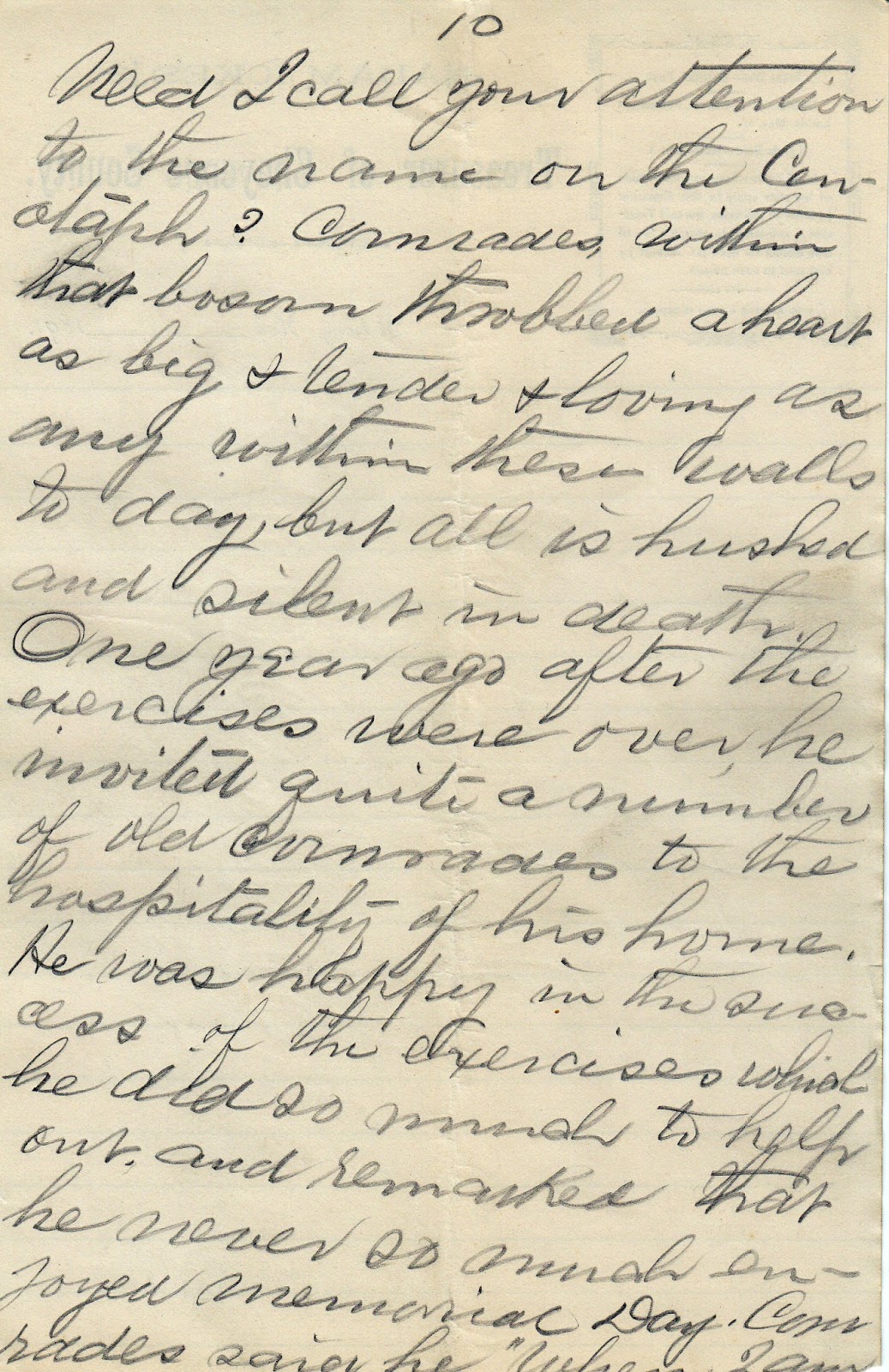
Need I call your attention to the name on the Cenotaph? Comrades, within that bosom throbbed a heart as big & tender & loving as any within these walls to day, but all is hushed and silent in death.  One year ago after the exercises were over he invited quite a number of old comrades to the hospitality of his home. He was happy in the success of the exercises which he did so much to help out and remarked that he never so much enjoyed Memorial Day. Comrades said he “When I am with you no more don’t forget Men. Day, but each year as long as there is one of you left turn out & honor the day & I have no doubt when the last comrade shall have answered the last roll call a grateful people will take up the work and hand it down to future generations.

Comrades, those of us who are here today, who have in years gone by joined with comrades and friends to honor the beloved dead, must not forget that way back in our eastern homes kind & loving hands have gathered choice flowers from field & garden & are placing wreaths upon the graves of our loved ones.

To us their comrades is given the duty of keeping fresh and green their memories; of perpetuating and transmitting intact to posterity the country perfected by their sacrifices & sufferings.

Resting from their labors, the story of their lives jeweled by deeds of valor & Patriotism shall inspire in the hearts of all the people a love for country & flag that shall keep the land forever united, beautiful & free.


Man is a rational being, susceptible of intellectual and moral culture. His present depraved state, the result of sin, subjects him to most of the ills of life, and makes him a creature of much unhappiness. The aches and pains of the body misfortunes in business loss of character and disappointed hopes are some of the evils that mar his enjoyment and very frequently make shipwreck of all that is noble & good in man.

Man, then is a wreck, and can never be saved without the influence of the gospel of Christ.  I think proposition is clear to the minds of all Christians. The heathen must have the gospel or remain in their degradation and filth. The plaguespots so abundant in nominal Christian lands can never be removed without the purifying influence of the gospel.  It is the only sure remedy for the evils of our present state of society. Many projects are set on foot now-a-days to improve the state of society; but all such attempts have failed, and must fail, where the gospel is not the main factor in the process of improvement; for the simple reason that all mere human arrangements do not and can not reach the seat of the moral disease which is the root of the evil. You may cultivate the intellectual faculties until the whole mass of the community be turned into philosophers, and yet make them no more moral than the poor untutored savage who bows down to sticks and stones.

They may be more refined and elevated but their moral nature will be no better. We see this illustrated in the so called higher classes all around us. All schemes that ignore the gospel must fail in the future as they have in the past.

We need nothing better than the gospel to regenerate the world. Bring the leaven of the gospel fairly into contact with fallen humanity and men are saved. They become sober, industrious, and pious. A portion of the working classes frequently complain of hard times. They organize themselves into unions and inaugurate strikes; they have been spending too much of their hard earnings on their lusts. Six hund[red]-mill[ion]s of doll[ar]s are wasted every year in the United States for strong drink; and I have no doubt that the laboring classes spend four hund[red] mill[ion]s of it! Is it any wonder that times are hard for them. By way of contrast I take two mechanics equal in training and skill – John Smith and George Jones – who work in the same shop and have been working there these ten years.  John is a sober, steady man, and a Christian. He has paid regularly for the support of the church say 25 to 30 doll[ar]s yearly yet he has prospered; he has his own neat cottage, well furnished and paid for, and has a few hundred laid up for a rainy day. His children were well clothed and went to school; his wife was always cheerful and happy.

But now let us look at the case of George. He had no confidence in religion; he thought it was nothing but priestcraft and superstition. He would think for himself, and do as he pleased. He could drink or let it alone.  He became a common drunkard; he drank up more than half his wages; he had no house of his own, he was always hard up, his children were uncared for unschooled, and neglected, his wife was soured, discouraged & untidy; she saw nothing but poverty and rags before her.  This is a picture that can be seen every day in almost every community in the land.

The temperance movement, where the gospel is excluded, will never save drunkards – at least not many of them. Men under the excitement of eloquent appeals may break off for a while but very often return to their cups. Liquor has destroyed the will-power, and they can not resist the temptation.  So of all other sins. How then are men to be saved without the gospel. Why do men murder each other and commit suicide?  Is it not because they have rejected the gospel? Send the gospel then to the heathen, and to those of our own land who have it not.  It will do more good than all the mere human organizations that ever have or can be made. The gospel is the power of God unto salvation; it is the great remedy God himself has given to heal the moral diseases of humanity. No other remedy is to be looked for. If this does not reach the case, then man is in a hopeless condition.  The great reformers of our day have much to say about the “gospel of humanity”, as if their notions were better than the gospel of Christ and would do more for the improvement of society.

The gospel of Christ is God’s remedy for the healing of the nations; and if this does not save and elevate mankind nothing else will.  Paul says “We must educate or perish” is a truth that has been fairly demonstrated in the past. But we need this gospel which so fitly teaches man the great fact of the brotherhood of our race, breaking the bondage of selfishness, and drawing the individual closer and closer into harmony with the great whole.

Touched by its magnetic influence man now feels the force of sympathy, gentleness and love, and begins to see, and act, and live as a brother of the common family. He realized the connecting link that binds him to the lowest state of humanity.

A man may be great in intellectual attainments, he may have “delved down deep and dragged up drowned honor by the books” but he needs this moralizing force in order to make him a man with a heart and a soul possessed of a centralizing force with which he is drawn to his fellow man by a power “he could not resist if he would, and would not if he could.”

I cling to the hope that in the eventualities of the race, though none of us shall live to see that happy day, the angels of Advent who sing the song of “peace and good will shall bend over their harps to pour raptures down upon a world grown green and blossoming with beauty – a world of teeming activity, invention and production in which love and good will shall dominate supreme.

Victor Hugo said, “if you want to reform a man you must begin with his grandmother” We may not be able to reach the grandmothers of our children but we have something to do with the child that is father of the man.

Man up a child ve (sic.).


Self-Reliance - Contributed


It was never intended that strong, independent beings should be reared by clinging to others for support. The misfortunes and trials of life are positive blessings. They strengthen his muscles, and teach him self-reliance, just as by lifting each day we increase our own strength.

All difficulties come to us like the lion which met Samson; the first time we encounter them they roar and gnash their teeth, but, once subdued, we find a nest of honey in them.

The greatest curse that can befall a young man is to lean, while his character is forming, on others for support. The oak that stands alone to content with the tempests’ blasts, only takes deeper root and stands the firmer for ensuing conflicts; while the forest tree, when the woodman’s ax has spoiled its surroundings, sways and bends and trembles, and perchance is uprooted, so it is with men. Those who are trained to self-reliance who have had to scratch for every inch of their life, are ready to go out and contend in the sternest conflicts of life; while men who have always depended upon others, are never prepared to breast the storms of adversity that arise.

The best capital, in nine cases out of ten, a young man can start with in the world, is robust health, sound morals, a fair intelligence, a will to work his way honestly and bravely, and if it be possible a trade. He can always fall back on a trade when other paths are closed.

Any one who will study the lives of memorable men, will find that a large majority of them rose from the ranks with no capital for a start save intelligence, energy, industry, and a will to rise and conquer.  The greatest heroes of the battle-field—some of the greatest statesmen and orators could boast no capital in gold to start. Not only in the getting of wealth, but also in the acquirement of various eminence – those men have won most who relied on themselves. The Alps stood between Napoleon and Italy, which he desired to conquer. He scaled the mountain and descended upon his prey.  So a barrier once scaled affords a vantage ground for our future efforts. Opposition gives us greater power of resistance.

It is cowardice to grumble about circumstances. Some men always talk as though fate had woven a web of circumstances against them, and it is useless for them to try to break through it.  It is their business to dash on in pursuit of their object against everything. There are multitudes of such men.  They are like summer vines which never grow up unsupported, but stretch out a thousand little hands to grasp the stronger shrubs; and if they can not reach them, they lie disheveled in the grass to be trodden by beast and beaten of every storm.

It will be found that the first real movement upward will not take place until in a spirit of resolute self-denial, indolence, so natural to almost every one, is mastered.

“If you would go up, go – if you would be seen, shine.”

People who have been bolstered up and levered all their lives are seldom good for anything in a crisis. When misfortune comes, they look around for somebody to cling to, or lean upon.  If the prop is not there down they go. When a child is learning to walk, if you can induce* the little creature to keep its eyes fixed on any point in advance, it will generally “navigate” to that point without capsizing; but distract its attention by work or act from the object before it and down goes the baby. 

To the young man favored with education, friends and all the advantages which could be desired as means to success, it is disgraceful to let those who stand in these respects at the beginning, far below him, gradually approach as the steady years move on, and finally outstrip him in the race.

A man’s true position in society – that which he achieves for himself – he is worth to the world no more, no less. He is a man for what he does, not for what his friends have done.

“If a boy is not trained to endure and to bear trouble he will grow up a girl; and a boy that is a girl has all a girl’s weakness without any of her regal qualities. A woman made out of a woman is God’s noblest work; a woman made out of a man is his meanest.”

A. I.

*not sure if this is the correct word


Only a Pansy Blossom


And it’s only a Pansy blossom,
Delayed until faded and old,
Among the neat folds of a letter
More precious than leaves of pure gold.

Its message was truthful though silent,
Collected by hands that are fair,
Kissed oft by the dews of kind heaven,
Eagerly, dearly by one there.

Sweet is the memory that lingers
Securely, of the by-gone years;
Each moment was golden and rosy,
Now passing with sadness and tears.

Dear friends we loved in the “good old time”,
Sustained by their memory ever;
Beyond the confines of earth and sky,
Endeared, we’ll meet ne’er to sever.

Slumber not while the present prevails,
The future is fraught with good cheer,
Wake up to the duty before you,
In every good work, be a peer.

Supreme be the power that guides us;
High and noble, the aim acquired;
Enduring, the faith that inspires; then
Shall we reach ev’ry state desired.

Together in friendship we travel
O’re life’s fitful, tempest-tossed sea;
Constant in season. So may the earth
Abound in rich blessings for thee.

Remember the sweet Pansy blossom;
Remember the glad days of yore;
I’ll cherish and treasure them, Carrie,
Ever, forever, evermore.


All original content, images, commentary, etc. copyright © by Joy Denison 2015-2016.  All rights reserved. All writings, poems, speeches, essays, images, scans, likenesses, etc. by Adam Ickes (b 1845) as well as personal histories, images, and all other content by all persons referenced and discussed within the pages and posts in this blog may not be copied, shared, or reproduced in any way without expressed permission by the owner unless included here from other referenced sources or are historical records already considered to be in the public domain. 

Tuesday, October 18, 2016

Ellen's Pin


Most of Adam's writings were folded in half lengthwise and secured together with  paperclips.  The pages of one essay in particular, entitled "Dress", were joined together in the top left-hand corner with this sewing pin. It didn't take me very long to realize that this pin would have belonged to Ellen.

Ellen's son, Horace, had written, "My Mother used to make our clothes, knit our woolen socks, and in fact everything we wore, except a pair of red top boots with which we were supplied in the fall for the winter. So that we would not grow out of our clothes they were made very large, the sleeves of our coats would extend several inches below our hands, then when we grew into them by that time they were wore out and we started all over again. Mother would work hard all day and then darn, mend and spin after the children had been put to bed."

My mother learned to sew from her mother.  When my two older sisters became interested in sewing I didn't want to be left out and insisted I be taught as well.  I was 7 years old.  Mom would put a stack of  Sears catalogs under the foot pedal of the sewing machine so my foot could reach it.  Without any thread in the sewing machine, I would practice sewing straight lines by following lines on notebook paper.  It wasn't long before I was making my own skirts, tops, and dresses.  By the time I was in Jr. high school I was sewing for friends to earn extra money. And by the time I was in high school I had made a few wedding dresses, dozens of costumes for the high school theater department, practically all of my own clothes and did quite a bit of sewing for my mom.

I sewed constantly for my children, especially once my daughter was born. I made her blessing dress, her wedding dress, and everything in between. I mended and hemmed and sewed on more scout patches than I could possibly count. And now I sew for my granddaughter. 

I have the original essays and speeches that Adam wrote.  I have buttons from his Civil War uniform. I have newspaper clippings and photos and enough information about him and his life to fill multiple blog posts. 

And I have Ellen's pin. Priceless. 


All original content, images, commentary, etc. copyright © by Joy Denison 2015-2016.  All rights reserved. All writings, poems, speeches, essays, images, scans, likenesses, etc. by Adam Ickes (b 1845) as well as personal histories, images, and all other content by all persons referenced and discussed within the pages and posts in this blog may not be copied, shared, or reproduced in any way without expressed permission by the owner unless included here from other referenced sources or are historical records already considered to be in the public domain. 

Friday, October 7, 2016

Living the Dream: A Culture of Patriarchy

When I embarked on the extensive project of transcribing and archiving all of Adam Ickes' writings (more about that later), I became so impressed with a couple of things he wrote concerning the value and place of women.  How did he, I wondered, escape the culture that so freely and fully invaded every nook and cranny of society from the beginning of time?  Men could dare to dream, to explore, and to venture beyond what was expected and familiar.  Women, however, (despite very few exceptions) existed only for the pleasure and comfort of men. 

One aspect of patriarchy and male entitlements involve the type and the division of labor between husbands and wives.  That didn't seem to be a problem for my early Bedford County ancestors.  As poor, hard-working immigrants, manual, back-breaking labor for both partners defined their occupations. Husbands and wives, moms and dads, both, equally, worked hard providing for themselves and for their families. They worked from sun up until sun down, and probably then some. The men worked in the fields as the women worked in and around home.  It was, by necessity, a cooperative effort.  And it paid off. For the most part, each generation acquired more wealth and security than the one previous.

If I had to guess, I would say it was probably my 3rd great-grandfather, Conrad, who first settled into a real posture of modern patriarchy. Shortly after the death of his first wife (and mother of his children) he remarried.  He placed all the work of his two farms on the backs of tenant farmers and retired to a house in town.  HE retired, but I'm 100% sure his wife did not.  All of the traditional women's roles of the day would have been expected of her on a daily basis, and she, I have no doubt, was quick to oblige. Studying his last will and testament, he kept tight reigns on his assests, leaving his wife for the most part only that which she brought into the marriage, and dictating his wishes concerning other aspects of his estate long after his death.  He wielded all the power and the control, of that there was no doubt.

Adam (Conrad's son) was not suited to follow the profession of his forefathers.  Farming was just not his thing. He valued education.  He loved learning!  It's so evident in everything he writes.  He referenced brilliant scholars and philosophers in so many of his essays and speeches.  He quoted them in such thoughtful and meaningful ways.  He was very well read. His career began as a teacher of children while a teenager himself.  Following his time in military service he served as a director in the school system and the superintendent of the Sunday School at the local Lutheran Church, indicating to me that inspiring others to pursue learning was of utmost importance to him.

Apparently, though, being a teacher and and scholar just didn't pay the bills.  His natural knack and interest in merchandising complimented his scholarly endeavors.  It enabled him to wear the clothing of a gentleman rather than that of a laborer.  He could continue to pursue his interests and indulge in the few finer things the small community of Pleasantville had to offer.  Ellen's life, however, probably didn't change much.  Unless a man could find his way into wealth, influence, and power, providing his wife with domestic help and high-end living, her life still revolved around the menial and tiring tasks of 19th century living.  And she had very little choice in the matter.  It was her lot in life.  

Throughout my personal family history, this pattern of men living the patriarchal dream - being free to pursue their interests and vocations however and wherever they choose - on the backs of submissive wives stuck in traditional household roles began with Adam and continued through the generations.  I won't delve into any of the details, but suffice it to say the non-questioning willingness of my youth to buy into the notion that "this is the way it is" and "this is the way it's supposed to be" and my feelings about it now are not one in the same.  I will add, however, I see progress - great, noticeable progress. 

Back to the first paragraph of this post.  Adam's writings often sang the praises of women.  As a Civil War veteran he gave many Memorial Day speeches and he wrote several versions of exactly the same speech.  In what I think was the last and final Memorial Day speech he gave he added a special tribute to the womens' contribution to the war effort.  It was beautiful and it had even greater meaning to me which I'll share in a subsequent post.  In another essay entitled "Dress" he wrote,

What multitudes of young women waste all that is precious in life on the finified fooleries of the toilet. How the soul of womanhood is dwarfed and shriveled by such trifles, kept away from the great fields of active thought and love by the gewgaws she hangs on her bonnet.  Woman was made for a higher purpose, a nobler use a grander destiny.
Her powers are rich & strong; her genius bold and daring, she may walk the fields of thought, achieve the victories of mind, spread around her the testimonials of her worth, and make herself known and felt as man’s co-worker & equal in whatsoever exalts mind, embellishes life, or sanctifies humanity.
(The second paragraph was actually not his own though he failed to provide a proper citation.  A quick google search told me that it came from: Weaver, G. S..  Aims and Aids for Girls and Young Women.  p 52. New York: Fowler and Wells, 1856. Google Books. Web. http:/books.google.com.)

Although he writes and proclaims his co-equality with women - that they should be given every opportunity to expand and explore, to think and achieve - that does not appear to be his lived experience.

From my last writing of Adam and Ellen they were living comfortably in Pleasantville PA.  Having both grown up there, they were surrounded by loving, extended family with deep connections of history and belonging.  I'm at a distinct disadvantage as I attempt to imagine the motivation and the repercussion that moving away from Pleasantville had on them as I really have no way of knowing for sure. But I'm going to imagine anyway. And I'm going to imagine it from a female perspective. And I'm going to do that because right now, at this particular point in time, my heart is turned away from Adam and is turned toward my 2nd great-grandmother, Ellen.  I'm speaking for her in a way she could never speak for herself.  I really don't care if I'm right or if I'm wrong.  I'm just going to tell the story the way that I see it and that I believe it to be from my 21st century feminist perspective. Because I'm not going to continue to use the culture of the past to explain away and to justify wrong doing.

As Adam ripped Ellen away from her beloved home and family, the vile and repressive culture of patriarchy reared its ugly head, robbing her of everything she held dear. It was Adam, not Ellen, looking for opportunity to expand and explore. It was Adam, not Ellen, positioning himself to achieve his own fame and fortune at Ellen's expense. For years and years he left Ellen virtually abandoned and completely void of any semblance of enrichment or self-fulfillment. The amount of hard labor he piled on her while he attended to his professional and civic duties I would consider exploitative and inhumane. Ellen endured. Ellen survived. But enduring and surviving doesn't equate with happiness. Ellen deserved a lot better. And now to tell her story...


All original content, images, commentary, etc. copyright © by Joy Denison 2015-2016.  All rights reserved. All writings, poems, speeches, essays, images, scans, likenesses, etc. by Adam Ickes (b 1845) as well as personal histories, images, and all other content by all persons referenced and discussed within the pages and posts in this blog may not be copied, shared, or reproduced in any way without expressed permission by the owner unless included here from other referenced sources or are historical records already considered to be in the public domain. 

Wednesday, October 5, 2016

The Writings of Adam Ickes, Reminiscences of the War


CHAPTER I 

It was on the sixth day of October 1864. I left home, family, friends and all to engage in the great conflict that threatened the disruption of the government and a disseverance of the Union. It had rained, the roads were muddy, but the falling snow about the first introduction to winter, instead of being exhilarating and cheerful, only added to the gloom of the occasion.

I got aboard a two horse wagon in company with others, destined for Mt. Dallas, where we took the cars bound for Huntingdon at the rate of about three miles an hour.  The roads were bad, we couldn't make time, but we landed at Huntingdon, however, some time in the evening, stopped off for supper, and after partaking of a hearty meal and spending a couple hours in a regular jollification, we got aboard the train for Harrisburg at which place we landed about one o'clock a.m. on the seventh. It was a long time till daylight lying on the floor of the old depot amid the profanity and whiskey and an occasional "Noo York" that issued from a heaving bosom. But then we must get used to it.

We left for Chambersburg about eight o'clock, ablebodied and all; the train was crowded with a mass of living humanity and the hideous "huzzas" of the sportive were almost deafening. A sharp brisk breeze was blowing and several hats emigrated through the windows but the boys had not time to get after them as we were traveling at a greater speed than on the Broad Road.

Chambersburg!  All got off and struck for refreshments after which we were ready for examination. This part of the ceremony was rather enjoyable. The examiner, after a careful "diagnosis," noted down the bearings, angles, latitude and longitude, density, complexion, color of eyes and hair, and then required you to "hop, step and jump" and turn a somerset or two, all of which gracefully done we were pronounced fit for service and ordered to the clothing depot, where we were dressed in a suit of blue with gilt buttons ornamented with the "American Eagle." We can imagine how new and blue we looked. If  there had been a mirror there we would have taken a peep, but mirrors are made for ladies and were not needed at that place. It was fun to see a fellow whose latitude was not in proportion to his longitude projecting through his pantlegs and coat sleeves, and the fellow who handed over the goods didn't go to much trouble to "pull down your best."

We were then marched down town to an old factory building of some kind where, under guard, we were to "put in" for the night. Before morning, however, the novelty of the thing began to wear off, and our mind wandered homeward; the soft bed, the loved ones, the table spread with variety and abundance: all loomed up in painful contrast with "hard tack" and solid floor. It was a long night, we would lie awhile on one side then gently turn the other.


The grey dawn of the morning at last appeared; we arose and fetched a sigh of relief as we learned that we were booked for Carlisle that day. We arrived safely sometime in the afternoon and upon entering the camp were greeted on all sides with the cry of "Fresh fish!"  "Fresh fish!"


CHAPTER II


I was pleased with the change, and my mouth watered in anticipation of "fresh fish."  What was my mortification, when at noon I handed my cup to a servant at the cookhouse and received a pint of bean soup and made the unpleasant discovery, somewhat to my chagrin, that the boys only hallooed "Fresh fish!" when a lot of new recruits came in. The bean soup was not of the kind neither that our ladies prepare when all needful articles are at hand, but resembled somewhat the kind for which "Mark Twain" gives a recipe. "Take some water, wash it well, then boil till it is brown on both sides, put in a bean and let it simmer until the bean gets uneasy, when it will be ready to bottle up."

I remained at Carlisle about four days when a detail of one hundred men was made to be sent to the front. I was one of the number. This squad of men was composed of almost all nationalities, professions and classes of society. We were promiscuously crowded into a box car consigned to Baltimore, at which place we arrived in the early dawn of morning Oct. 12th. We were driven through the city and herded in the streets like so many cattle until about four o'clock, when we marched to the wharves where amidst crabs, bologna, pies, cakes and women we got aboard a fine steamer bound for Fortress Monroe. 

Proudly we sailed out on the Chesapeake, amid the cheering multitude our gallant bark ploughing through the waves of the deep, distancing all others until at length the city was lost to sight in the azure blue of the distance.

It was a beautiful night. The sun had sunk beneath the western horizon; the twilight of eve was magnificent; the orb of night with its myriad lamps shone resplendent from the vault above. While we stood upon the upper deck viewing the vast sheet of water on either side, our trusty and tried monarch of the waters rushed grandly along at the rate of about ten miles an hour. After a thrill of admiration in contemplating our surroundings, we retired to the lower deck where upon bunks we turned in for the night.

I did not awake until about sunrise when our steamer touched the wharves at Fortress Monroe. Some of the boys did not fare so well. Their slumbers being interrupted by "sea sickness," that "horror of horrors," that indescribable something, finding its way inward, surging and heaving and sighing, with all the fury of an Etna or Vesuvius, leaving its victim as helpless as a dried lemon.

No casualties. We got aboard another steamer headed up the James River we knew not whither. Late in the afternoon we landed at City Point where we were transferred from travel on water to a short overland trip by rail. About ten o'clock that night we arrived at our place of destination: "The Army of the Potomac" on its approach to Petersburg, Va.


CHAPTER III


The fame of the "Army of the Potomac" had spread over the earth. It was considered the strong right arm of the nation, and although it had suffered serious reverses yet it had achieved brilliant successes. The victory at Gettysburg was a grand achievement for the northern arms and a fearful calamity to the southern cause. The blow struck causing Lee's army to recoil and retreat, was a shock from which the noble "Army of Virginia" never fully recovered. I felt highly honored and shall always take pride in saying that I was a member of the "Army of the Potomac."

I slept that night upon the ground with but few wrappings, in the great wide ampitheater whose roof was the sky. In the morning I beheld a sight never before witnessed from the foundation of the world; the sun arose in the west, passed over the northern heavens and set in the east. I saw it and who shall contradict it?

I was assigned to Co. I 91st Reg't Penn. 3rd Brigade 1st Division 5th Army Corps, and with Washington D.C. attached, that made a nice postal card on the back of a letter for the address from home. Some of the boys realizing our close proximity to the rebels and the dangerous ground we occupied, began to repent, and thinking perhaps the wrong "tag" had been placed upon us and that we had been misshipped, desired that I should go and speak to the officers saying that we were all "green horns" without any training in the manual of arms or military drill, but I wasn't quite that green, I declined. I was pale, however, for I realized that we were in the midst of a hornet's nest as it were and right near the business end of some of them. An occasional boom of cannon with a more frequent crack of musketry convinced me of that fact.

About the first thing we did was to put up shelter tents in which we constructed cottage beds made with pine pole slats and pine top mattresses. These completed, we were called out to drill. When the fun commenced, we were formed in two ranks, the tallest men on the left graded down to the smallest on the right. In order to form a straight line, we were instructed to cast an eye to the left, taking a waist button on the coat as a sight, some being full breasted and others--well, if they had been turned around they would have made better sights,--however, the officers would pass along the rear and round off the sharp angles by a gentle tap of the sword. After a right face, left face, and about face we were ordered to march, the officer in command leading off with --left--left--left-- when to our mortification, from some unknown quarter, a wag, a cruel, hard hearted uncouth rogue chimes in with--"left a good home."


CHAPTER IV


We continued drilling day after day for about one week when we were furnished with brand new Springfield Rifles and accoutrements. We were then drilled in the manual of arms and felts ourselves soldiers full fledged. We had an agreement with the veterans that they should do the most hazardous duty which was picketing near the line of the enemy, while we done the camp duty. It was a wilfull and malicious imposition as we had a great deal to do while they had but little. But then we were cowardly and stupid and bore our burdens without complaint.

I began to feel at home and tried to relish the inevitable. "Hard Tack" and the sweet juicy tender “white meat" carved from the side of that well known animal "the hog."

Early in the morning of October 27th, about 3 weeks from the day we left home, it pleased his honor Gen'l Grant to make a demonstration on the left, with a view to lengthening the line of fortifications and if possible destroy the South Side R.R., thereby destroying and cutting off the most direct line of supplies and compel Lee to evacuate Petersburg. We were getting along admirably in the morning, but the sagacious Lee seemed to have anticipated the march, for we found the enemy in force ready to receive us.

Then came the tug of war; it was a warm reception they gave us, but we contested the ground bravely until about 2 o'clock when it became necessary for us to retire. We advanced rearward with considerable alacrity. Our line was reformed when we hastily constructed breastworks, under cover of which we remained until about noon of the next day awaiting the enemy. They did not come but were setting a trap in which to "coop us up" and came very near doing it. They had observed a breach in our line and, pushing rapidly in, were soon upon our left flank in force. It became necessary for us to retire. The exigencies of the hour made it imperative. The order was sent along the line in a whisper and we retired on a doublequick step in great quietness, it was like the rushing of the wind, until out of danger, when the stillness was broken by the cheers of the retreating columns.

We returned to Camp having accomplished but little. I was reliably informed the next morning that of our noble little squad of 100 of whom I wrote in a former article about one half were among the killed, wounded and missing. The thick woods rendered artillery useless, but the roar of musketry the whizzing of bullets, the shouting of the brave mingled with the shrieks of the wounded and the groans of the dying was a scene of suffering so heart-rending, so horrifying as to excite the sympathy and pity of a bitter enemy who will tarry to offer a cup of cold water.


CHAPTER V


After returning to our camp, some of the boys were so much bewildered that they could scarcely recognize the place. We now felt that we were fairly initiated; indeed, the ceremony was so impressive and so real that in the fierceness of the onslaught one would try to seek shelter behind a sapling one inch in diameter. Your humble servant would have attempted to enter the earth through a two inch hole if there had been one. I was almost as much frightened as Mark Twain's horse when kept at bay by a buffalo. He said, 'The horse actually stood on his head and shed tears."

I was next placed on a picket post. The picket line was about one fourth of a mile in advance of the main line of works, and men were stationed about fifty yards apart called videttes a short distance in front of the posts. It was a position of great responsibility, as upon the vigilance and watchfulness of the videttes depended in a great measure the safety of the army. The penalty for sleeping on this critical post was death. I was posted as a vidette, fully instructed and charged to remain at my post for two hours when I would be relieved by another.

My second turn came about midnight. The corporal accompanied me to my post, and there in the blackness of the night all alone, I was to remain one hour. There was not a rift in the clouds that even a star might lend a cheerful ray of light; there was not the sound of a rustling leaf to break the stillness. Oh! the dismal forebodings of that dark hour; to have relieved the painful monotony of that occasion, it would have been a pleasure to have embraced even a pig.

While contemplating the dread loneliness, all of a sudden as if to mete out a full measure of misery something dropped with a thud upon the ground within about six feet of me. Holy horror! My form was heightened at least two feet, my hair stood on end, my knees flopped, and I verily stopped breathing for the space of several minutes. I felt as miserable as the poor cowardly fellow who, when urged on to the fight by his captain upon being told that he was the biggest baby in the world, replied that "he wished he was a baby and a "gal" baby at that, then he wouldn't be there, now nor never."

It was nothing but a falling burr from a pine tree under which I was standing.  That hour of centuries finally came to an end and I was relieved. We remained on picket for two days when we were relieved and returned to camp to my great gratification and joy. Our Father's God: from out whose hand, poor mortals fall like grains of sand.


CHAPTER VI


We now had a short period of rest, passing the month of November without anything noteworthy and until about the second week in December, when we were sent on a raid down through Virginia for the purpose of destroying the Danville rail-road. If that trip was not passing through the mire and the clay, then I never saw mud. We continued the march until the road was finally reached, requiring several days.

About ten o'clock at night, in as quiet a manner as possible through the thick darkness, a force of men stretching for several miles marched in upon the road and, when the command was given, laid hold and with sledges soon wrought destruction complete. The ties were put upon piles, and the rails thrown on top. The torch was then applied, thus rendering the rails unfit for immediate use.

Having accomplished the task of destroying the road for several miles, the extreme inclemency of the weather rendered any further operations into the country of the enemy highly impracticable. After passing a night of intense suffering on account of snow and sleet without shelter, and with but little fire, we retraced our steps and were again on our way back to camp.

The return was rather enjoyable, as we foraged the country for miles around in search of good things, making contraband whatever we found. This would not have been permitted but in retaliation for the perpetration of dastardly and brutal crimes upon our stragglers while on our way down, by guerrillas who infested that neighborhood. "Apple Jack" and "Peach Brandy" were found in abundance in the cellars, and some of the boys filled their canteens and stomachs too to their full capacity. Like "Doesticks" on a “bender at Niagara" they then proceeded to drink some “Apple Jack" and then drank some “Apple Jack" to take the taste out of their mouths.

We had plenty of chicken, fresh pork and mutton for variety. It was sport to see a party surround a flock of sheep, shooting promiscuously, every fellow for his mutton, while a man was in as much danger perhaps as the sheep. 

Upon our arrival near the defenses in front of Petersburg we went into camp in regular “winter quarters," in the rear of the main line. Our picket duty was now on the rear of the army. I was on picket "Christmas Eve," heard the bells ringing in Petersburg. We had no Christmas trees but plenty of other kinds of trees. No cakes and candles and presents there, but I was feeling about as miserable as a boy who had eaten about two pounds of candy, one gallon of peanuts, one of oranges and two pounds bologna. I had attempted that day to eat a camp kettle full of “vegetable soup."


CHAPTER VII


I survived the agony suffered from the effects of the "vegetable soup" and in a few days was back again to camp. It now looked as if we were to remain in camp for some time. Winter had set in and the heavy rains that fell rendered the roads in such a condition as to make it almost impossible to move the wagon trains.

We now tried to make ourselves as comfortable and cozy as possible. I sent to New York for a lot of pictures and decorated the walls of my tent. They were pictures of ladies, and on Sunday morning, when our quarters were inspected as to cleanliness or lice and filth, the officers would enter my tent and feast their eyes for several minutes.

Camp life was not all monotony; part of the time was very pleasantly passed in reading letters received from home and answering the same. Some of the boys would indulge in a game of "euchre" or "seven up"; in fact, play all day, putting up heavy stakes, and when money and sutler checks were exhausted, they would represent cash by chips of pine bark. I never indulged in a single game of cards.

On day we received intelligence of a "box" that was on the way from home, filled with good things by kind friends and loved ones. With what eagerness we looked for that box, and it was so long coming. Every day some one or two went to the station to inquire, but no box. We had almost despaired ever getting it when one evening, almost to our surprise, it came. We almost worshiped that box, we turned it over and over until some one suggested that we had better open it and see if every thing was in good order.

The box was opened, and the boys, well, they were men but then they acted like five year olds, danced around in high glee. What a feast of fat things--cakes and pies and stuffed chickens and dried beef and dried corn and canned fruits and butter and jam and ham and a vast amount of other articles too tedious but not "tasteless" to mention. It is needless for me to say that these good things did not last long and no one can describe how much we relished these dainties until he has subsisted for about four months on hard tack and bacon.

Nothing of importance transpired until after the first of February, during which time we grew fat and lazy. My weight when we went into camp was one hundred and forty five. During the stay there I gained steadily until I tipped the beam at 165lbs.

One evening there was quite a commotion in camp, men were running hither and thither; at length the excitement grew intense and almost produced a panic; men were calling "What is it? Where is it?" I finally discovered it was something I had not seen since I left Baltimore, a woman.


CHAPTER VIII


On Sunday morning, February 5th, 1865, the quiet rest of the sabbath was broken, and our enjoyment of camp life again disturbed. We were called out under light marching orders to make another demonstration on the left.

The day was damp and chilly; we continued our march until after night fell, when we were in such a position as to expose our whereabouts by the building of fires. As the cold grew more intense, the temptation to build fires increased, and about 10 o'clock that night the camp fires burned brightly all around.

About midnight we were ordered into line to resume the march, moving off to the right and in the direction of the South Side rail-road. We had not gone far until we were obliged to ford a stream, thus getting very wet and rendering the march exceedingly uncomfortable.

About daylight we came to a halt, immediately upon the left of the second corps, and saw the line of the enemy's works. We were cold and shivering; all our efforts to kindle fires having failed, it was with difficulty that we kept from freezing. We began to build “breast works" for our protection and warmed up to a certain extent in that way.

In the afternoon there was heavy fighting on our front and right, and about five o'clock in the evening we were called upon to relieve our line of battle and charge the enemy, who had by this time become fully aware of our intentions and massed heavily in our front. After getting into line by a flank movement I have never understood, we opened a volley of musketry and shell that made the earth tremble beneath our feet. Volley after volley was fired, and the enemy from behind their works were hurling the missiles of death thick as hail into our ranks, comrades were falling upon my right and left. It was almost a "hand to hand" encounter; we were within fifty yards of the enemy's works.

At length our line began to waver and fall back, and but for the timely arrival of Gen'l Warren, who in the thickest of the fight rode up to the front cheering and urging his men on to the fight, our line would have fled in great confusion. Thrice did we charge those works and as many times repulsed, until a tremendous fire was heard upon our left flank, creating the alarm that the enemy was upon our left flank and rear. The wildest confusion prevailed and our line fled in great disorder through the swamp and thick woods, the best fellow foremost, on and on until we reached our line of works. 

I lost my hat, but I was still better off than the young man who went west and, meeting several reverses, wrote his father that he had done well enough but that he would be home on a certain day--and requested his father to meet him in the evening just out of town. He said, "Bring along a clock or a pair of pants. I have a hat."


CHAPTER IX


We were utterly routed defeated, and demoralized. The stampede was not arrested until we were under cover of the works that had been erected early in the morning near Hatcher's Run. A few among the number who attempted to cross the run found watery graves; as for myself, I preferred to take the hazard of braving the enemy.

We were rapidly preparing to give the enemy a warm reception, but the approach of night prevented their further pursuit and they abandoned the chase. It was a couple hours before we all got together and perfect harmony restored. I found all of my comrades, none wounded or missing and we rejoiced together that once more we had passed through the fierceness of a bloody contest unhurt.

A detail was made and a line of skirmishers put forward in order to prevent a surprise. I was one of the number, and the scenes of that long, dark night were so vividly impressed upon my mind that death alone will perhaps erase. To be alone in the thick woods, amid darkness so dense that one could almost feel it, sent a thrill of desolation and gloom through my whole body. Hours turned into weeks and it seemed that morning would never come.

I had hoped to be relieved in the morning, but not so, the order came to advance; and after establishing a new line, my turn came to go on post as a vidette. I was told to advance about fifty yards, but not finding a good place for shelter and protection, I went about twenty five yards further to a large tree.

The rebel picket was not on the opposite side of the same tree, but the next tree by and about twenty five yards. I did not see him until I had stopped and began to take a survey of my surroundings. I then realized that it was important for me to be a good boy, as I was in a very critical place, perhaps the most critical of my life. I had no support, as my comrades on my right and left had not advanced more than half as far.

I did not fear the "reb" in front, but his supporters; the one on the right could make me stand around so that I was exposed to the fire of the one on the left. I had to remain there all day, as I could not be relieved until after dark. To add to the unpleasantness of the situation, there were two dead men lying within a rod of me. 

The experience of that day begat within me a disgust for hunting that has remained until this day. The only thing that saved me was the fact that they did not shoot at me nor I at them, for all of which I was most profoundly grateful.


CHAPTER X


We remained on picket about three days, when we were relieved and sent back.  After completing our lines of works, we again recrossed Hatcher's Run and went into winter quarters. We had been right well punished, though not without inflicting heavy losses upon the enemy, for having advanced into the territory of our foe. Although we had not accomplished all that we desired, yet we had increased and strengthened our hold upon the throat of the rebellion. The Union armies were now holding a line of thirty miles in extent, and large as their numbers were, at some points they were greatly attenuated.

Nothing of great importance transpired in the Army of the Potomac until the last of March, during which time we grew fat and lazy.

The time for a final move, which should overwhelm Lee's Army and compel its surrender, was rapidly drawing nigh. On the 24th of March, Gen'l Grant issued instructions to his three army commanders, Meade, Ord and Sheridan, to be in readiness to move on the 29th of March. While these preparations were making for a general crushing attack, Gen'l Ire, in his desperation, essayed a counterattack, anticipating the movements of the Union armies by three days. And though success was hardly possible with such odds as he had to contend with, yet the attack was well planned, and came near proving a success.  Had it done so, it must have materially retarded, and for a long time paralyzed, the intended movement.

One of the points where the attenuation of our line was greater than it should have been was at Fort Stedman and its immediate vicinity. Fort Stedman was a square fort, covering about an acre of ground. It was the second regular fort in the line of Union fortifications confronting Petersburg on the right. Against Fort Stedman, before break of day March 25th, the rebels were massed for a charge. Lee's objects in this attack was to turn the guns he should capture upon the Union troops, wheel his troops to the right, and march down the line, thus threatening the whole line.

At day break, they rushed to the attack. The space between the opposing lines was only 150 yds. They captured the fort at once, so skillfully, boldly, and rapidly was the assault executed, that the garrison, numbering about 500 men, was captured with scarcely a show of resistance.

Their onward progress was now checked by Fort Haskell, together with the Union batteries from all quarters, concentrated their fire upon Fort Stedman. Our whole line was in motion; we had just got up and was wiping our eyes and some were cooling their coffee when the drums beat "fall in"; and under light marching orders we were soon on our way to the scene of action. We had not gone over a mile until the news came that the enemy had been beaten back. 

We remained in readiness for action all day, and late in the evening we were permitted to charge the enemy on the left. We supported a battery. This was the prettiest sight I witnessed while in service. It beat any 4th of July celebration I ever saw.


CHAPTER XI


About 10 o'clock that night we retired from the field and returned to our quarters, where we were soon snugly asleep, and woke up on Sunday morning to find all quiet as though nothing had occurred to mar the peace of camp life.

On Wednesday morning being the 29th of March, the movement of which I wrote in my last was commenced. The sun was scorching hot, and the air oppressive. The road was strewn with blankets, overcoats, and surplus clothing for miles. An immense army was in motion and everything looked favorable to the defeat of the enemy and the capture of Petersburg and Richmond.

It was on this occasion that Gen'l Grant sent the following memorable dispatch to Sheridan. "Push around the enemy and get onto his right and rear. We will act together as one army. I now feel like ending the matter before going back."

Toward evening of that day, we heard heavy firing in front, and a heavy detail was made to skirmish on the left. I had been excused from duty on account of the other service rendered, but thinking we were nearing a heavy engagement in front, I volunteered to go on the skirmish line and that was where I was taken in. We had not gone far until we were charged by the rebel skirmishers followed by line of battle.

An amusing incident occurred on the skirmish line between the contending parties. A couple "Johnnies" attempted to take a couple "Yankees" prisoners, but they were stubborn and wouldn't go. Finally, the "Yanks" saw our line of battle approaching on doublequick and the enemy fall back, and when the contesting "Johnnies" attempted to make their escape, the "Yanks" held them fast and they were prisoners of war.

At night when I returned to the regiment, I learned that they had not been in the engagement at all. I learned a lesson then that I have not altogether forgotten, "never to go when not called, or wanted."

During that night and until the morning of 3lst, the rain fell in such torrents as to make it impossible to move a wheeled vehicle. We spent most of the time in fortifying our position at night, and in morning advanced to a new position. Drenched with rain, and fatigued with marching and labor, about 10 o'clock a.m. 31 of March, we were relieved and sent to the extreme left of the line where we built fires and were just opening our letters and reading, while drying our clothing, when the drums again beat "fall in."

The enemy in great force had attacked our line on the right and about two miles distant.  Doublequick time was beat and we barely reached the scene of conflict in time to save the day. We were quickly wheeled into line, and the retreating columns, defeated and in great confusion, passed through our line. It required about all the courage and moral firmness cool men could command to stand firm amid such confusion and await the enemy.

On they came, but we reserved fire until they were within easy range, when as if by magic the whole line opened a terrific yell and the very earth trembled beneath our feet as the missiles of death were hurled into the ranks of the enemy.


CHAPTER XII


Many happy firesides were made vacant in that short but quick and decisive engagement; and many loving and tender hearts throbbed with deep emotion when the sad intelligence of the death of a father, a brother, a son or a lover, reached the homes of loved ones. The enemy were soon routed and severely punished before making their final escape.

We remained in position until after nightfall, when our brigade was ordered to make a detour into the territory of the enemy, to learn if possible of the whereabouts of Sheridan's cavalry, who had encountered the enemy upon their retreat. Sheridan's flank had been turned and a portion of his command surrounded, and only escaped becoming prisoners of war by a bold dash, cutting their way through the lines of the enemy.

In the stillness of that dark night nothing was heard save the tread of footmen and the clash of officers' side arms. In almost breathless silence we pushed forward until about midnight, when the desired information was obtained, and after a short rest we retraced our steps and returned to the main line.

At break of day we were again on the march, traveling over the same ground of the night previous, but not in as much suspense. About ten o'clock that day, April 1st, 1865, we formed a junction with Sheridan. He it was that was to lead us on to victory that day. It was the first time we saw him. His fame and the magic of his presence as it cantered by our columns gracefully, upon his noble black steed, inspired us with renewed courage and strong hope of success that day.

He was not long in making arrangements for carrying out his plans. The only thing he did that caused us sorrow and regret, was to relieve Gen'l Warren from duty. Our corps commander, that noble, brave and good man, than whom none was more beloved by his men, must now give place to another because he withheld our division the previous day, intending to give us a little rest when it was thought he should have used his whole corps. We were called into action and saved the day as I have already indicated, but the defeat of our third division was perhaps the cause of Sheridan's flank being turned and thus preventing a conjunction that day as Sheridan had anticipated.

Major Gen'l Griffin, who commanded our division, now was placed in command of the corps. Glorious results awaited us that day. The capture of thousands of prisoners and munitions of war, together with that long coveted prize, the "South Side Rail Road." It was all done by hard work, striking hard blows in front, next on the flank, and finally in the rear.  We supported the cavalry, and it was doublequick from noon till sunset. I did not think man capable of so great physical endurance.


 A Final Note by William K Ickes (my dad):
The last page of Adam Ickes' handwritten script ends with the words "to be continued." Yet no additional pages of script have been found. Perhaps they were never written, or perhaps they were written and lost. We will never know the end of the story as he experienced it. To know the end of the story we must turn to what history tells us.

The next day, April 2, 1865, General Grant began an attack all along the line. The death and destruction of the Rebel forces was awesome as thousands of Federal troops moved forward to the weakened center of the Confederate line until they established a breach. Richmond and Petersburg were left unprotected. In the resulting drunken frenzy, looting and killing by local riffraff went unchecked. Richmond and Petersburg fell on April 3, 1865.

General Lee, with his starving, ragtag army, moved westward toward Danville with the Federal troops nipping at their heels. They spent the night of April 3rd at Amelia Courthouse. Food was not to be found. They lost valuable time on April 4th foraging the countryside to find whatever food was available. On the morning of April 5th, a forage wagon returned with a disappointing amount of food. Lee tried to move south from Amelia, but Federal troops had already secured that escape route. He moved westward toward Farmville, where he hoped to receive provisions from Lynchburg. The night march was very costly with the loss of more Confederate lives.

On April 6th the Federals caught Lee at Sailor's Creek, captured his supply wagons, and Anderson's Corps and Ewell's Corps were left in ruin. Lee sadly observed the remnant of his army and was heard to say, "My God, has the army been dissolved?" He lost between 7,000 and 8.000 men that day.

The Confederate troops reached Farmville on April 7th, where food awaited Lee's starving men. Still not willing to quit, Lee felt that there still might be a chance if he could reach Appomattox, feed his men, then turn south for Danville.

On April 8th he was forced to fight a rear guard action when the Federal troops caught up with him. The battle at Appomattox was futile. What was left of his dwindling forces was beaten and mauled.

Lee put on a fresh uniform on Sunday, April 9th, and went forth for a final battle.  When he had no options left, he told his men that he was going to meet with Grant and surrender his army. Grant and Lee met at the McLean house in Appomattox Courthouse, where the terms of the surrender were discussed and accepted. There was some mopping up to do, but the war virtually ended at Appomattox Courthouse on April 9th, 1865.


What dad failed to realize was that Adam's division continued on to Appomattox Courthouse and was stationed there on April 9th, 1865, although we don't know Adam's exact proximity to the courthouse itself.  It was his 20th birthday.  It took him until July to return home.


All original content, images, commentary, etc. copyright © by Joy Denison 2015-2016.  All rights reserved. All writings, poems, speeches, essays, images, scans, likenesses, etc. by Adam Ickes (b 1845) as well as personal histories, images, and all other content by all persons referenced and discussed within the pages and posts in this blog may not be copied, shared, or reproduced in any way without expressed permission by the owner unless included here from other referenced sources or are historical records already considered to be in the public domain.