Showing posts with label Cheyenne County Treasurer. Show all posts

Thursday, October 20, 2016

The Writings of Adam Ickes, Part 3

Since none of these are dated I have no idea when they were written.  


Dress


“God has put on robes of beauty and glory upon all his works. Every flower is dressed in richness; every field blushes beneath a mantle of beauty; every star is veiled in brightness; every bird is clothed in the habiliments of the most exquisite task. The cattle upon the thousand hills are dressed by the hand divine.”

To love dress is not to be a slave of fashion. Beauty in dress is a good thing, rail at it who may. But they love dress too much who give it their first thought, their best time, or all their money, who for it neglect the culture of mind or heart, or the claims of others on their service, who care more for their dress than their disposition; who are troubled more about an unfashionable bonnet than a neglected duty. Female loveliness never appears to so good an advantage as when set off by simplicity of dress.  A vulgar taste is not to be disguised by gold & diamonds. Through dress the mind may be read, as through the delicate tissue the lettered page. A modest woman will dress modestly; a really refined woman will bear the marks of careful selection and faultless taste.

A coat that has the mark of use upon it is a recommendation to the people of sense, and a hat with too high luster a derogatory circumstance. The best coats in our streets are worn on the backs of penniless folks, clerks with pitiful salaries, and men that do not pay up. The heaviest gold chains dangle from the fobs of gamblers and men of limited means; costly ornaments on ladies, indicate the fact of a silly lover or husband cramped for funds. Women are like books – too much gilding makes men suspicious that the binding is the most important part. The love of beauty and refinement belong to every true woman. She ought to desire pretty dresses, and delight in beautiful colors and graceful fabrics; she ought to take a certain pride in herself – exhibiting good taste, to care for harmony and fitness of things, the cleanliness of her surroundings, and good style of her arrangements; she ought to set the seal of gently woman on every square inch of her life, and shed the radiance of her own beauty & refinement on every material object about her.

What multitudes of young women waste all that is precious in life on the finified fooleries of the toilet. How the soul of womanhood is dwarfed and shriveled by such trifles, kept away from the great fields of active thought and love by the gewgaws she hangs on her bonnet. Woman was made for a higher purpose, a nobler use a grander destiny.

“Her powers are rich & strong; her genius bold and daring, she may walk the fields of thought, achieve the victories of mind, spread around her the testimonials of her worth, and make herself known and felt as man’s co-worker & equal in whatsoever exalts mind, embellishes life, or sanctifies humanity.”*

Dress affects our manners. A man who is badly dressed feels chilly, sweaty, and prickly. He stammers and does not always tell the truth. He means to, perhaps, but he can’t. He is half distracted about his pantaloons, which are much too short, are constantly hitching up; or his crumpled linen harrows his soul, and quite unmans him.

He treads on the train of a lady’s dress, and says “thank you,” sits down on his hat, and wishes he was in the “deseret (sic.) of Sahara”.

Young ladies, never refuse to see a friend because you have on a wash gown. Be assured the true gentleman will not think less of you because he finds you in the performance of your duties & not ashamed to let it be known.

There is a grace about an everyday dress that adds to every charm of face & feature.
A. I.


* Weaver, G. S..  Aims and Aids for Girls and Young Women.  p 52. New York: Fowler and Wells, 1856. Google Books. Web. http:/books.google.com.


Comrades of the G. A.


Ladies and Gentlemen
This beautiful custom of a grateful people had its origin in 1862 one year after the fall of Fort Sumter. In May of the following year the same sadly pleasant attention was rendered to the graves of soldiers buried at Fredericksburg, Md.

The custom became so popular and met with such unqualified approval that in 1873 through the efforts of that noble volunteer soldier the lamented John A Logan congress declared the 30th of May a legal holiday. And now another year in life’s campaign brings again to Memorial Day with its sad memories and tender associations and as the nation bends over the graves of its heroes and pays to noble dust the tributes of its love, let us remember that we are not only to cast any floral offerings upon the graves of our former comrades in arms, but standing in their presence to rededicate ourselves to the unfinished work they have left us to do.

Friends, upon this closing day of the budding Spring, “when hoary frosts have fallen in the fresh lap of the crimson rose”, our smiling land presents a scene that should forever blot from the record the slander of the poet and the silly carping of the politician. Millions of people have gathered today to sing psalms of gratitude to their sleeping benefactors, and with one loud voice to chant anthems of sweet appreciation that may rise from earth to heaven like “Sabean ordors* from the spicy shore of Araby the blest”. We have come to claim our share in this beautiful and grateful service, & to perform our harts (sic) in an act that possesses no quality of a task. To be an American citizen officiating in a service of gratitude to the fallen of his country is but second to being numbered among those to whom this homage is rendered. 

No wonder the hearts of the boys of ‘61 swell with patriotic pride and with streaming eyes witness the demonstrations made on this day. Farmers and laborers lawyers & doctors ministers and teachers and men of all professions turn aside from their avocations to honor this day no matter what they may think of the surviving comrades they can not forget what they did.

No more lofty acts are to be found in the records of authentic history than the noble sacrifices of the American soldier upon the field of battle and the votive offerings of his countrymen upon the holy altar of his memory. Over two million brave patriots voluntarily left their homes their families and their peaceful pursuits to defend upon battle-plain and over the swelling wave the principle then submitted to decision under the dread arbitrament of arms. The contest was fierce & long nor ceased until over 300,000 graves marked the no. slain, nor until 300,000 union soldiers and sailors were made cripples for life, and left more than a million devoted mothers, widows, sisters, and orphans &c &c**.

We are not here to talk of the causes that led to this great sacrifice. Men & women are before me to day who have come upon the stage of life and action since that appalling event occurred that know as
*odours **Etc. etc. well as the actors in it the sad story of that blighting conflict when the strength of the Republic was tried in the fire of steel. In all ages of the world flowers have been used to represent the verdict against the hopeless doctrine of final extinction. The growth of flowers in Spring indicate the revival of the fruitful earth after a period of quiet &c .

In the ancient Republics of Greece and Rome the crown of honor was made of laurel. Victors in the Pythian games were crowned with a wreath of laurel leaves as a symbol of triumph and all down the vista of ages flowers have been largely used as a device of heraldry. The fleur de lis became the national emblem of France, the thistle of Scotland and the shamrock of Ireland. The important feasts of all the churches are now celebrated with flowers. Every religion that promises a renewal of life after the sleep upon earth symbolizes its faith through the blooming beauties of the floral tribes.

From the baptismal font to the last couch of man there lies but a single step; and the rose which unfoldes its crimson petals to the morning air of the child may in the evening give place to the gentle amaranth, as it speaks of hope from the grave of man.

Comrades and friends, we have come with beautiful flowers, culled by the hands of our brothers and women into speaking forms by the fair fingers of our sisters, to render the homage due to patriots who have died for their country & for all mankind.

                “Bring flowers then, to their memory;
                Throw hither all your quaint, enameled eyes,
                That on the green turf sucked the honeyed showers,
                And purple all the ground with vernal flowers.
                Bring the rath primrose that forsaken dies;
                The tufted crow-toe and the pale Jessamine;
                The white pink and the pansy, streaked with jet;
                The glowing violet,
                The musk-rose, and the well-attired woodbine,
                With cowslips was that hand the pensive head,
                And every flower that sad embroidery wears.”

We stand to-day at the graves of comrades who marched with us one year ago. At these graves we are reminded that our ranks are rapidly thinning and with each vacant place come new and weightier responsibilities.’

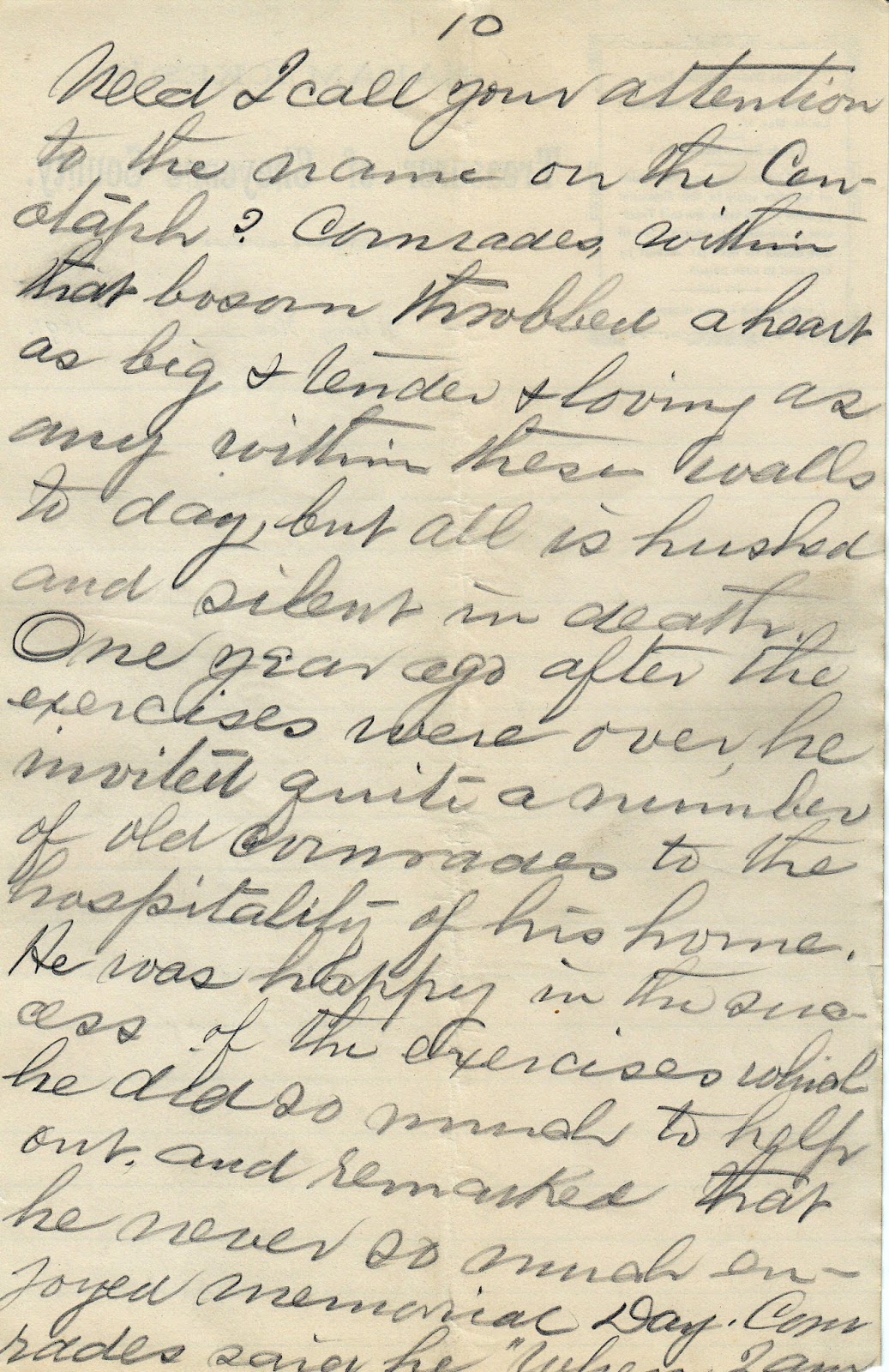
Need I call your attention to the name on the Cenotaph? Comrades, within that bosom throbbed a heart as big & tender & loving as any within these walls to day, but all is hushed and silent in death.  One year ago after the exercises were over he invited quite a number of old comrades to the hospitality of his home. He was happy in the success of the exercises which he did so much to help out and remarked that he never so much enjoyed Memorial Day. Comrades said he “When I am with you no more don’t forget Men. Day, but each year as long as there is one of you left turn out & honor the day & I have no doubt when the last comrade shall have answered the last roll call a grateful people will take up the work and hand it down to future generations.

Comrades, those of us who are here today, who have in years gone by joined with comrades and friends to honor the beloved dead, must not forget that way back in our eastern homes kind & loving hands have gathered choice flowers from field & garden & are placing wreaths upon the graves of our loved ones.

To us their comrades is given the duty of keeping fresh and green their memories; of perpetuating and transmitting intact to posterity the country perfected by their sacrifices & sufferings.

Resting from their labors, the story of their lives jeweled by deeds of valor & Patriotism shall inspire in the hearts of all the people a love for country & flag that shall keep the land forever united, beautiful & free.


Man is a rational being, susceptible of intellectual and moral culture. His present depraved state, the result of sin, subjects him to most of the ills of life, and makes him a creature of much unhappiness. The aches and pains of the body misfortunes in business loss of character and disappointed hopes are some of the evils that mar his enjoyment and very frequently make shipwreck of all that is noble & good in man.

Man, then is a wreck, and can never be saved without the influence of the gospel of Christ.  I think proposition is clear to the minds of all Christians. The heathen must have the gospel or remain in their degradation and filth. The plaguespots so abundant in nominal Christian lands can never be removed without the purifying influence of the gospel.  It is the only sure remedy for the evils of our present state of society. Many projects are set on foot now-a-days to improve the state of society; but all such attempts have failed, and must fail, where the gospel is not the main factor in the process of improvement; for the simple reason that all mere human arrangements do not and can not reach the seat of the moral disease which is the root of the evil. You may cultivate the intellectual faculties until the whole mass of the community be turned into philosophers, and yet make them no more moral than the poor untutored savage who bows down to sticks and stones.

They may be more refined and elevated but their moral nature will be no better. We see this illustrated in the so called higher classes all around us. All schemes that ignore the gospel must fail in the future as they have in the past.

We need nothing better than the gospel to regenerate the world. Bring the leaven of the gospel fairly into contact with fallen humanity and men are saved. They become sober, industrious, and pious. A portion of the working classes frequently complain of hard times. They organize themselves into unions and inaugurate strikes; they have been spending too much of their hard earnings on their lusts. Six hund[red]-mill[ion]s of doll[ar]s are wasted every year in the United States for strong drink; and I have no doubt that the laboring classes spend four hund[red] mill[ion]s of it! Is it any wonder that times are hard for them. By way of contrast I take two mechanics equal in training and skill – John Smith and George Jones – who work in the same shop and have been working there these ten years.  John is a sober, steady man, and a Christian. He has paid regularly for the support of the church say 25 to 30 doll[ar]s yearly yet he has prospered; he has his own neat cottage, well furnished and paid for, and has a few hundred laid up for a rainy day. His children were well clothed and went to school; his wife was always cheerful and happy.

But now let us look at the case of George. He had no confidence in religion; he thought it was nothing but priestcraft and superstition. He would think for himself, and do as he pleased. He could drink or let it alone.  He became a common drunkard; he drank up more than half his wages; he had no house of his own, he was always hard up, his children were uncared for unschooled, and neglected, his wife was soured, discouraged & untidy; she saw nothing but poverty and rags before her.  This is a picture that can be seen every day in almost every community in the land.

The temperance movement, where the gospel is excluded, will never save drunkards – at least not many of them. Men under the excitement of eloquent appeals may break off for a while but very often return to their cups. Liquor has destroyed the will-power, and they can not resist the temptation.  So of all other sins. How then are men to be saved without the gospel. Why do men murder each other and commit suicide?  Is it not because they have rejected the gospel? Send the gospel then to the heathen, and to those of our own land who have it not.  It will do more good than all the mere human organizations that ever have or can be made. The gospel is the power of God unto salvation; it is the great remedy God himself has given to heal the moral diseases of humanity. No other remedy is to be looked for. If this does not reach the case, then man is in a hopeless condition.  The great reformers of our day have much to say about the “gospel of humanity”, as if their notions were better than the gospel of Christ and would do more for the improvement of society.

The gospel of Christ is God’s remedy for the healing of the nations; and if this does not save and elevate mankind nothing else will.  Paul says “We must educate or perish” is a truth that has been fairly demonstrated in the past. But we need this gospel which so fitly teaches man the great fact of the brotherhood of our race, breaking the bondage of selfishness, and drawing the individual closer and closer into harmony with the great whole.

Touched by its magnetic influence man now feels the force of sympathy, gentleness and love, and begins to see, and act, and live as a brother of the common family. He realized the connecting link that binds him to the lowest state of humanity.

A man may be great in intellectual attainments, he may have “delved down deep and dragged up drowned honor by the books” but he needs this moralizing force in order to make him a man with a heart and a soul possessed of a centralizing force with which he is drawn to his fellow man by a power “he could not resist if he would, and would not if he could.”

I cling to the hope that in the eventualities of the race, though none of us shall live to see that happy day, the angels of Advent who sing the song of “peace and good will shall bend over their harps to pour raptures down upon a world grown green and blossoming with beauty – a world of teeming activity, invention and production in which love and good will shall dominate supreme.

Victor Hugo said, “if you want to reform a man you must begin with his grandmother” We may not be able to reach the grandmothers of our children but we have something to do with the child that is father of the man.

Man up a child ve (sic.).


Self-Reliance - Contributed


It was never intended that strong, independent beings should be reared by clinging to others for support. The misfortunes and trials of life are positive blessings. They strengthen his muscles, and teach him self-reliance, just as by lifting each day we increase our own strength.

All difficulties come to us like the lion which met Samson; the first time we encounter them they roar and gnash their teeth, but, once subdued, we find a nest of honey in them.

The greatest curse that can befall a young man is to lean, while his character is forming, on others for support. The oak that stands alone to content with the tempests’ blasts, only takes deeper root and stands the firmer for ensuing conflicts; while the forest tree, when the woodman’s ax has spoiled its surroundings, sways and bends and trembles, and perchance is uprooted, so it is with men. Those who are trained to self-reliance who have had to scratch for every inch of their life, are ready to go out and contend in the sternest conflicts of life; while men who have always depended upon others, are never prepared to breast the storms of adversity that arise.

The best capital, in nine cases out of ten, a young man can start with in the world, is robust health, sound morals, a fair intelligence, a will to work his way honestly and bravely, and if it be possible a trade. He can always fall back on a trade when other paths are closed.

Any one who will study the lives of memorable men, will find that a large majority of them rose from the ranks with no capital for a start save intelligence, energy, industry, and a will to rise and conquer.  The greatest heroes of the battle-field—some of the greatest statesmen and orators could boast no capital in gold to start. Not only in the getting of wealth, but also in the acquirement of various eminence – those men have won most who relied on themselves. The Alps stood between Napoleon and Italy, which he desired to conquer. He scaled the mountain and descended upon his prey.  So a barrier once scaled affords a vantage ground for our future efforts. Opposition gives us greater power of resistance.

It is cowardice to grumble about circumstances. Some men always talk as though fate had woven a web of circumstances against them, and it is useless for them to try to break through it.  It is their business to dash on in pursuit of their object against everything. There are multitudes of such men.  They are like summer vines which never grow up unsupported, but stretch out a thousand little hands to grasp the stronger shrubs; and if they can not reach them, they lie disheveled in the grass to be trodden by beast and beaten of every storm.

It will be found that the first real movement upward will not take place until in a spirit of resolute self-denial, indolence, so natural to almost every one, is mastered.

“If you would go up, go – if you would be seen, shine.”

People who have been bolstered up and levered all their lives are seldom good for anything in a crisis. When misfortune comes, they look around for somebody to cling to, or lean upon.  If the prop is not there down they go. When a child is learning to walk, if you can induce* the little creature to keep its eyes fixed on any point in advance, it will generally “navigate” to that point without capsizing; but distract its attention by work or act from the object before it and down goes the baby. 

To the young man favored with education, friends and all the advantages which could be desired as means to success, it is disgraceful to let those who stand in these respects at the beginning, far below him, gradually approach as the steady years move on, and finally outstrip him in the race.

A man’s true position in society – that which he achieves for himself – he is worth to the world no more, no less. He is a man for what he does, not for what his friends have done.

“If a boy is not trained to endure and to bear trouble he will grow up a girl; and a boy that is a girl has all a girl’s weakness without any of her regal qualities. A woman made out of a woman is God’s noblest work; a woman made out of a man is his meanest.”

A. I.

*not sure if this is the correct word


Only a Pansy Blossom


And it’s only a Pansy blossom,
Delayed until faded and old,
Among the neat folds of a letter
More precious than leaves of pure gold.

Its message was truthful though silent,
Collected by hands that are fair,
Kissed oft by the dews of kind heaven,
Eagerly, dearly by one there.

Sweet is the memory that lingers
Securely, of the by-gone years;
Each moment was golden and rosy,
Now passing with sadness and tears.

Dear friends we loved in the “good old time”,
Sustained by their memory ever;
Beyond the confines of earth and sky,
Endeared, we’ll meet ne’er to sever.

Slumber not while the present prevails,
The future is fraught with good cheer,
Wake up to the duty before you,
In every good work, be a peer.

Supreme be the power that guides us;
High and noble, the aim acquired;
Enduring, the faith that inspires; then
Shall we reach ev’ry state desired.

Together in friendship we travel
O’re life’s fitful, tempest-tossed sea;
Constant in season. So may the earth
Abound in rich blessings for thee.

Remember the sweet Pansy blossom;
Remember the glad days of yore;
I’ll cherish and treasure them, Carrie,
Ever, forever, evermore.


All original content, images, commentary, etc. copyright © by Joy Denison 2015-2016.  All rights reserved. All writings, poems, speeches, essays, images, scans, likenesses, etc. by Adam Ickes (b 1845) as well as personal histories, images, and all other content by all persons referenced and discussed within the pages and posts in this blog may not be copied, shared, or reproduced in any way without expressed permission by the owner unless included here from other referenced sources or are historical records already considered to be in the public domain. 

Friday, October 14, 2016

Adam Ickes and Elizabeth Ellen Harbaugh Ickes - Sidney, Nebraska, Part...um...I've Lost Count


Adam Ickes


There is no 1890 census in existence, but the 1890 veteran's census shows the Ickes family living in Potter, NE, so we know Ellen and Alle are still parked on the homestead.  (We know that from the homestead documents as well.)

April 1890 began the establishment of the town of Ickes, Nebraska - complete with a post office set up to serve 75 people. Here's the history as listed online:

"John Brayton had asked to name the post office Fairview. However, that name was crossed out and Ickes written instead. The original location was about 10 miles west of Dalton on Road 58, about 1 mile west of Jay Peter's home (NE 1/4, 34-17N-51W).

"Local information indicates that the post office was in the home of Jacob P. Eckert. John E. Sanders then moved it to his home, the location being 6-16N-51W, close to where Phil Sanders lives on road 56. At some point, it may have been moved again, as Davison's petition for a site change showed a map locating Ickes in the SW part of NW 1/4 26-17N-51W, or about a mile north of the proposed change. On Aug. 18, 1894, James Davison requested locating the Ickes Post Office to SE 1/4, 26-17N-51W, which is where Jay Peter's now lives, about 9 miles west of Dalton on Road 58.

"The Ickes Post Office was closed on August 15, 1915.

"There is a historical marker on that spot commemorating the Ickes Post Office."


Lincoln Evening State Journal

July 25, 1936


(transcript)

Old Water Holes All That Is Left of Pioneer Town of Ickes
SIDNEY, Neb. (AP). One of the last outposts of a frontier civilization that sprung up with the building of the railroad was the old town of Ickes, population seven, located in Cheyenne county about 35 miles northwest of Sidney.

Actually there is no town left on the old site of Ickes, altho [sic] the census maps list it as possible the smallest town covered by the 1930 population county. There never was much of a town, pioneers recall, but the old postoffice and frame ranch house that once occupied a remote spot on the western prarie were welcome sights to many a frontiersman and rancher in the days of horse and buggy travel.

Ickes was named after Adam Ickes, western Nebraska pioneer. The postoffice was near a series of water holes fed by springs, and Ickes was more of a watering stop for stock than a haven for human beings. Yet the old settlement lived for years after civilization settled the panhandle, and it became somewhat of a tradition in the rich history of western Nebraska.

Adam Ickes was the first treasurer of Cheyenne county. In those days Cheyenne county covered most of western Nebraska and it was a good week's journey to cover it from border to border by horseback or buggy. The town of Ickes actually consisted of a crew of ranch hands, together who whoever happened to be postmaster at the time. Never in its history did Ickes have more than eight or ten persons.

Nothing remains to mark the old town site except a few scattered farm dwellings and the old water holes. Pioneers can point out the exact spot where the old postoffice was located, but that section is now served by rural mail route. Adam Ickes has been dead many years and no other members of the family are living in Cheyenne county.


Horace got married in September of 1890 and sometime after that, he didn't say exactly when, moved to Cheyenne, Wyoming and then to Sterling, Colorado where my grandfather, William Bunn, was born in 1895.  So with business dropping off and Horace leaving it could have been sometime after 1890 that Adam relocated his business to a smaller store as discussed in an earlier post. 

16 May 1891 Adam delivered an address to the Sidney, Neb. Teacher's Institute.


Intellectual and Manual Education


The education of the hand must be recognized to be just as necessary as the education of the head.  Our reason should be cultivated because it is one of God’s best gifts to man, the argument applies equally to our bodily powers.  Nearly all men encourage or sanction the intellectual education of the masses as public expense by the public, but, the manual education of the masses is only looked after by the parents, and too often sadly neglected by them.  Parents are very often at fault in permitting their children to grow up without a knowledge of manual labor.  Their sons may be able to unravel knotty problems in mathematics, give an intelligent reason why water will not run up full, but they are unskilled in the use of the saw the hatchet the plow and the hoe and I have seen those make a miserable failure in the attempt to harness and hitch a house to a wagon.  Their daughters can entertain company, talk of the true the beautiful and the good converse freely and intelligently on various topics, discuss the fashions of the day and such like, but they are ignorant of household duties from the cellar up and could not for the life of them make a respectable looking roll of butter or bake a loaf of bread.

It is just as necessary for a man to know how to earn his living as it is to know how to vote.  “Is ignorance dangerous to the commonwealth?”  Idleness is equally dangerous.  “Does the education of the head prepare a man for the better discharge of his social duties?”  So does the education of the hand.  Learning is the ally of morality and virtue”.  So is manual labor.

Learning gives a man a feeling of independence and self-respect, so does industry.  Learning tends to keep a youth from low company and base habits, so does industrial labor.  Physical training is just as necessary for the full development of personal character as intellectual training.

Physical development is essential to the growth and vigor of the mental faculties.  Who does not admire the well developed country lad or lass with sun burn hands and face but with the glow of health and vigor beaming in their countenances, having the courage and strength to hew their way to success.

To be skilled in the capacity of a farmer or tradesman does not unfit a man for the highest profession.  It is rather a source of pleasure and gratification to the professional man to be able to take up a hammer and nicely shape a piece of iron or to turn a furrow with a plow, and vice versa the skilled mechanic or farmer delights in rich intellectual treats.  The martyr Lincoln was a rail-splitter, the hero Grant was a tanner and the lamented Garfield endured the kicks and cuffs administered to subordinates on the ferry boat.

“Man can not live by bread alone”.  The possession of a good common school education, which was once so rare as to be a mark of distinction, is now so common as to be noticed only when it is wanting.  Our wonderful facilities for elementary education has flooded the country with teachers, lawyers, doctors, clerks, salesmen, runners and petty traders.  The evil seems to be that of making a discrimination in favor of the man that lives by his wits, and against the man that lives by the sweat of his face.  Therefore in the train of our immense army of producers and distributors there is following another army of hungry camp-followers, without either the hands to produce or the head to distribute, but with stomachs that must be filled at the expense of honest producers and distributors, and this army is daily increasing in numbers and acquiring strength by organization.  We have now companies, we shall ere long have regiments of tramps bummers, loafers, rough, gamblers and one horse politicians.  What shall we do to correct this evil and stay the ride that is drifting to ruin and desolation so many thousands of our population?

Teachers, we turn to you, a grave and fearful responsibility rests upon you.  You are to lead the onward way to higher and better things.  Your calling high advanced, calls with noiseless and persuasive voice to universal progress.  Are you making the most of your calling?  Will your conduct stand the crucial test of a noble life?

May we not hope that a thorough practical common sense intellectual and manual education of the masses will teach all the plain duty of life and that while the ladder may be crowded there is plenty of room at the top.

A. I.

5/16/91

Sidney, Neb. Teacher’s Institute


And apparently this had been going on...


 Omaha Morning World Herald
September 5, 1891


Omaha World Herald
October 23, 1891


So this Edward McLernon guy was in cahoots with the county board to get Adam thrown out of office and take his place, even though Adam had been re-elected.  Apparently they didn't trust him with the county's money. (Go figure.) The local courts couldn't find cause to force him to vacate his position, so McLernon took it all the way to the Nebraska Supreme Court.  The supreme court sustained the lower court's decision.  Either Adam didn't run for a third term or he was defeated. His political career ended at the end of 1891.

At least his good name wasn't completely tarnished as he delivered a patriotic address on the 4th of July in Chappel, NE.  (I don't have the speech - only the newspaper clipping.)


Omaha World Herald
July 5, 1892


Adam began selling life insurance to supplement his income.  


North Platte Tribune
March 22, 1893


North Platte Tribune
March 21, 1894


Later, Adam's daughter, Alle, wrote, "He tried farming on a homestead in Pumpkin Creek Valley, Cheyenne County but had to give it up, and then he took up writing Life Insurance for the Mutual Life Insurance Co. of New York." But by 1890 Cheyenne County had already been divided and Pumpkin Creek Valley was in Banner County, so maybe she meant he tried farming on his own homestead outside of Potter.  Who knows?  All we know from the above newspaper clipping is that he was still in Sidney in 1894.  And that's the last time we find him there.

The Sidney, Nebraska roller coaster ride had finally come to a stop.


All original content, images, commentary, etc. copyright © by Joy Denison 2015-2016.  All rights reserved. All writings, poems, speeches, essays, images, scans, likenesses, etc. by Adam Ickes (b 1845) as well as personal histories, images, and all other content by all persons referenced and discussed within the pages and posts in this blog may not be copied, shared, or reproduced in any way without expressed permission by the owner unless included here from other referenced sources or are historical records already considered to be in the public domain. 

Pandemonium and the Sidney Banking Fiasco

Omaha Daily Bee
June 28, 1889


(highlights)
Sidney, Neb., June 27. - S.C. Morgan, cashier of the State Bank of Sidney, committed suicide this morning, shooting himself through the head with a Colt's 45 pistol.  He was in bed at the time.

It appears that this morning Morgan called John Echert, who is working at the house, to go up to the bank to get Joe Sharmer's "pop," as he wanted to kill some rats. John got the pistol, brought it to the house and placed it on the table, saying, "here is the pistol," and went out.

At 11 o'clock he returned to tell Morgan his wife had not arrived, she being in Omaha visiting and was expected home to-day. Eckert saw blood on the bed and rushed uptown to inform Sharmer.

The sight that met their gaze was a ghastly one--Morgan lying in bed dead, with the top of his head blown off, the pistol lying along side of him.

Sheriff Eubank and jury have been taking evidence, and everything leads to the theory of suicide. The bank is now closed, but Sharmer assures everybody the financial condition of the bank is unimpaired.

Mr. Frank Johnson, cashier of the Bank of Commerce, who is associated with Mr. Morgan in the bank at Sidney, stated that he could offer no explanation of Mr. Morgan's rash act.  The financial condition of the bank was excellent, and as far as he could ascertain, Mr. Morgan's business and domestic relations were unclouded.


Omaha Daily Bee
June 29, 1889


Omaha Daily Bee
June 30, 1889


Omaha Daily Bee
July 2, 1889


Omaha Daily Bee
July 3, 1889


Omaha Daily Bee
July 4, 1889


(highlights)
Sidney, Neb., July 3. - Frank B. Johnson . . . arrived here on Friday morning at 10 o'clock.  At the depot a large crowd had congregated with eager expectancy to get a glimpse of the man who was to straighten the then unsettled condition of the bank's affairs.

Morgan committed suicide on Thursday morning about 7 o'clock.  The news was spread about 11. Your correspondent immediately went to Joe Sharmer, the old reliable clerk in the bank, and asked him to inform him on the dead square if everything was all right in the bank, as it had become noised around that there was a deficit.  Sharmer said everything was all right and nobody would lose a cent. He had "telegraphed to Frank Johnson, the president of the bank, to come up at once," and later he confirmed it by showing your correspondent a telegram from Johnson saying that he (Johnson) would be here in the morning.

It turned out that Sharmer was ignorant of the true condition of the finances of the bank.

Johnson...in company with J P Cavanaugh, an Omaha attorney...entered the bank accompanied by Sharmer and Adam Ickes, the county treasurer, and James Sutherland of North Platte.

They saw enough of the bank to assure them that there was a large deficit, but when interrogated on the subject they would invariably answer, "We can't make a report yet and it will take several days, as the books have not been posted in nearly two weeks."

...a few of the creditors began suit and had papers served on Johnson as the surviving partner.

When the west-bound train arrived at 10 o'clock p. m. and Sheriff Eubank was presenting his documents to Johnson summoning him to appear in court on August 5 to answer these suits, he got aboard the train, saying he was going to Cheyenne and would be back on Saturday afternoon to assist a committee of three in further examining the books.  He never returned, but it is learned that he took the B & M train for Omaha.  He never intended to come back here.  The result was that County Treasurer Ickes, who has $17,000 deposited there, went to Omaha on Sunday in company with Mr. McIntosh, where they will probably enter suit.

The people here are determined to make Mr. Johnson pay up every dollar, and no compromise will be effected.


Omaha Daily Bee
July 7, 1889


Omaha Daily Bee
July 8, 1889


Nebraska State Journal
 July 12, 1889


(highlights)
Omaha, Neb., July 5 - From the time the bank opened it seemed to prosper.  Morgan was popular with all classes, and the financial standing of his partner aided in securing business.  For nearly three years his was the only banking institution in Sidney, and after a time he was unable to do the business alone.  He then employed Joseph Sharmer, an honest gentleman of some means, to assist him. Morgan always kept the books, and his employee's duties were to pay the checks presented and make out the drafts of the bank's correspondents....At his house he lived very plainly, and his parties did not occur oftener than once a year.  He never played cards for money, and his most intimate friends say he never had any desire to deal in options or futures.  When he opened the bank he adopted the rule never to use liquor during business hours, and rigorously adhered to it. 

The affairs of the bank disclose about $11,000 of not gilt edged paper, no money and $3,000 or $4,000 of real estate.  What has become of the difference is a great question with Sidney's people. Morgan had not squandered it, but where is it? It is generally believed to be somewhere in Omaha, but how it got into the Nebraska metropolis is another unanswered query.

It is believed here that Morgan fully realized when he went home the last time that his bank could not open the next day.  He had no money in the safe and his remittances from Omaha were very uncertain.  The Nebraska banking law he knew would go into effect on the following Monday, his Cheyenne creditors were clamorous for the payment of their claim, he had been unable to dispose of his bank's good will at satisfactory figures, under his agreement he would soon be compelled to yield possession of the building in which he was located and his bank was without funds - these facts the people of Sidney believed dethroned his reason and compelled him to take his own life. 


Omaha Daily Bee
July 19, 1889


Omaha Daily Bee
July 23, 1889


Omaha Daily Bee
July 25, 1889


Omaha Daily Bee
 July 30, 1889


(highlights)
The situation of the State bank affairs this week is practically unchanged, so far as the payment of the bank's debts is concerned.  After much delay, and the breaking of many promises, J.P. Cavanaugh, Mr. Johnson's representative in the matter, arrived in the city, presumably for the purpose of making propositions for settlement.  Johnson's agreement with Messrs. McIntosh and Ickes it is true left out of sight all such things as propositions.  He agreed to assume and take charge of everything.  In the event of his keeping his word a proposition would have been entirely unnecessary.

The proposition appeared quite fair, though it was not by any means what Johnson had promised, and Cavanaugh was asked to put it on paper, that the individual opinions of the creditors present might be had. Mr. Cavanaugh did this, but produced a document so completely different from his verbal proposition that he was told without further argument that negotiations might stop if he had nothing further to offer.

The matter will be taken into the courts if necessary and Mr. Johnson will find himself confronted with facts that to say the least will not be pleasant.


Omaha Daily Bee
August 1, 1889

("Mr. Rickets" mentioned in the article
actually refers to Adam Ickes.)


Nebraska State Journal
August 9, 1889


In a nutshell, the bank partner/cashier committed suicide because all the money was gone.  Nobody really knew where it went.  Frank Johnson initially denied being a partner in the bank then tried having his lawyer negotiate a settlement with all of the bank's creditors.  By August, they're still negotiating and hoping to make a deal. Ultimately though, Adam was responsible for ALL of the county money.  If Frank Johnson couldn't come up with it Adam was supposed to make good on it.

It appears that Adam's term in office was two years and he was up for re-election. I'm not exactly sure of the purpose of his next speech - I guess it could have been delivered at a political rally - actually, I really don't know what to think. It was written on the back of Cheyenne County Treasurer stationery.


Unappreciated


Under this head there seems to be two classes viz: The unappreciated and those who do not appreciate.  The first class appear to be the most numerous.  It is certainly not a pleasant thought if we have genius, that the world refuses to recognize the fact.  To shoulder a musket in the army when we have enlisted to wear the start of a general is hard; and we are often obliged to follow where we think we ought to lead, therefore we are not appreciated.

There is danger of too high an estimate of our ability, we often confound the aiming at a mark with hitting it, thus failing to merit a high estimate of our ability.  We do not enter the avocations of life by bringing into requisition all the zeal the energy and the powers of our being but ask for harvests without plowing or serving, wages without thought or work.

Are there not many of us who sometimes think others are in our places, that we have been overlooked and that positions intended for us to fill have been usurped by others?  The world may be very slow to find us out, we may seek for place and may not find it, but if we are truly worthy we will be found at last.  But, of one thing we may be assured that whether we are found or not the world will move on today and tomorrow and forever.  Great men only have climbed to imperial heights by slow, hard and patient toil.  It is the only sure, safe and successful path through which all must travel in order to gain prominence.  We are often too ready to conclude that because we are not in affluent circumstances we are shorn of certain privileges in society, and this seems to be the case more especially with the female sex.  This ought not so to be; it is possible for the poorest the humblest in this glorious land of freedom to outshine in beauty of character the glittering gold of the millionerre (sic.); it is not in gaudy dress or sparkling pearls, but in the culture of the mind and the heart that we are brought into prominence before the world.

We sometimes think that our opportunities have passed by and with sincere regret look back and wail and lament over neglected duties and wasted privileges when you, yea even wish that we were a “robust boy” at fifteen or a rosy cheeked girl at “sweet sixteen”, with what energy and determination would we enter upon the work before us; forgetting all the while that all of us were girls and boys once and did not then think of it.  The future is before us, many of us perhaps have not lived out half our days and if we have neglected our youth let us begin now and by faithful hard and earnest work endeavor to retrieve our loss.

We would not have you believe that all talent comes to the front, that all persons may be brought prominently before the world; for it is possible that,

“Full many a gem of purest ray serene
The dark unfathomed caves of ocean bear
Full many a flower is born to blush unseen
And waste its sweetness on the desert air”.

We shall now attempt to say something about that class who do not appreciate.  It must be a great comfort to some failures that the fault rests not with them but us; for surely it is a strong proof of smallness of brains on our part that we can not rise up to the sublime appreciation of this world’s heroes – these poets, politicians, lawyers, doctors and philosophers all kept down because we don’t appreciate them, well, if we hav’nt (sic.) the ability to appreciate, then that ought to be the end of it; for surely no man is responsible beyond his actual capacity.  We very often fail to appreciate real merit, because of inattention or a certain dislike, whereby we do not suffer ourselves to become interested, conseqnently (sic.) we are not benefitted.  Perhaps the fault lies at our own door and if we can not appreciate, we should at least have the goodness to allow our neighbor to hear and enjoy the benefit by not ignorantly and willfully exhibiting a want of appreciation.  Our eyes have pained and our feelings revolted at young men and ladies too, who not only do not allow themselves to be interested, but by talking and laughing to the annoyance of others near them have shown a lack of culture rather than that of appreciation.  It’s an evidence of ill-breeding that ought to be frowned down; it’s a crime that ought to be punished; it’s shallow and disrespectful and merits the condemnation of all sober-minded good thinking people. 

A studied effort should at least receive our respectful attention, for in no other way are we capable of rightly judging as to its merits. Because we don’t like the cut of a man’s coat or that he wears a cuff for a collar or articulates through his breathing apparatus, is no reason why we should not appreciate his effort, especially if it be logically arranged, showing evidences of thought and study; neither should we pass lightly upon the studied effort of a lady though we may not admire her beauty or approve the train she draws after her.

In conclusion, would we be appreciated?  Then let us endeavor to prove ourselves worthy of it by diligent duty and faithfulness.

Would we appreciate?  Then let us show it by not only standing out of other people’s way when they are entitled to the way, but by a manifestation of that esteem and respect which are the true characteristics of a noble culture.

A.I.

Sidney 8/23/89


Believe it or not, Adam was re-elected County Treasurer of Cheyenne County Nebraska for another term.  But back to wrap up the whole banking fiasco.  

Being privy to future documents and newspaper articles helps put some of the pieces together within this time frame.  I'll start with all the rest of the documentation available to me.


Omaha Evening World Herald
March 3, 1893


Omaha Morning World Herald
May 8, 1894


(transcript)
CHEYENNE COUNTY FUNDS.
J. J. McIntosh, treasurer of Cheyenne county, was asking $9,000 in Judge Blair's court Monday as a balance due on an $18,000 account which Cheyenne county had with Frank B. Johnson, one of the proprietors of the now defunct Bank of Sidney. This balance was an account still due, 1889, it is alleged, when S. C. Morgan, Johnson's partner, died tragically and the bank failed. The court decided that the evidence failed to show that Johnson was interested in the bank at the time of the deposit and decided in his favor.


SUPREME COURT OF NEBRASKA

[decision in McIntosh v. Johnson]


JAMES J. MCINTOSH, TREASURER OF CHEYENNE COUNTY, NEBRASKA, v. FRANK B. JOHNSON. 
No. 7211. 
SUPREME COURT OF NEBRASKA 
March 17, 1897, Filed 
PRIOR HISTORY: [***1] ERROR from the district court of Douglas county. Tried below before BLAIR, J. Reversed. 
DISPOSITION: REVERSED AND REMANDED. 
COUNSEL: L. F. Crofoot, Breckenridge & Breckenridge, and W. P. Miles, for plaintiff in error. 
Wharton & Baird, contra. 
JUDGES: NORVAL, J. 
OPINION BY: NORVAL 
OPINION: [*34] NORVAL, J.

During 1888, and a part of 1889, the defendant, Frank B. Johnson, and one S. C. Morgan were partners engaged in a general banking business at Sidney, Cheyenne county, under the firm name and style of the State Bank of Sidney. In the latter part of June, 1889, Mr. Morgan died, leaving the defendant the sole surviving partner, and the bank being insolvent at the time, closed its doors, and did not afterwards resume business nor pay its depositors. From January 7, 1888, to June 26, 1889, both dates inclusive, Adam Ickes, the treasurer of Cheyenne county, in his official capacity deposited in said bank, on open account, large sums of money belonging to the county, and withdrew a portion thereof as required for use. On the day the bank suspended payment Mr. Ickes, as such county treasurer, had upon deposit therein county funds to the amount of $ 17,357.40. Plaintiff is the successor in office [***2] to the said Adam Ickes, and as such instituted this suit to recover from the defendant, as surviving partner, the sum of $ 11,857.40, alleged to be the balance due the county of Cheyenne on account of the moneys so deposited in said State Bank of Sidney. A trial of the issues raised by the pleadings was had to the court, resulting in a finding and judgment against the plaintiff. Two defenses are relied upon by the defendant to defeat the action, to-wit: (1.) Neither the county of Cheyenne nor the plaintiff ever had any [*35] legal claim against the defendant or the State Bank of Sidney on account of the funds deposited by Treasurer Ickes. (2.) Accord and satisfaction. These propositions will receive attention in their order.

The first contention is to a greater or less extent sustained by two decisions of this court, viz., State v. Keim, 8 Neb. 63, and First Nat. Bank of South Bend, Ind., v. Gandy, 11 Neb. 431, 9 N.W. 566. The first case was an action by the state to recover certain public funds belonging to it which had been deposited with the defendants, who were engaged in the banking business at Falls City, under an agreement that it should [***3] be delivered upon demand. It was held there could be no recovery, since the deposit was unauthorized, and there had been no ratification of it by public law. The writer by no means concedes that an illegal or unauthorized deposit of state moneys in a bank constitutes no cause of action in favor of the state to recover such moneys; but accepting the decision in State v. Keim to be sound, is it decisive of the question before us? We do not think so. After it was rendered the legislature, in 1879, passed the following act, which received the approval of the executive:

"An act to provide for the collection of public funds and moneys.
"Be it enacted by the Legislature of the State of Nebraska:

"Section 1. That in all cases in which public moneys, or other funds belonging to this state, or to any county, school district, city, or municipality thereof, have been deposited or loaned to any person or persons, corporation, bank, copartnership, or other firm or association of persons, it shall be lawful for the officer or officers making such deposit or loan, or his or their successors in office to maintain an action or actions for the recovery of such moneys deposited or loaned, [***4] and all contracts for the security or payment of any such moneys or public funds made shall be held to be good and lawful contracts binding on all parties thereto; Provided, Nothing herein contained shall be construed to in any manner affect the [*36] liability of any surety or signers of any official bond heretofore or hereafter given or made in this state.

"Sec. 2. All actions heretofore brought by any public officer, either in his own name or officially, for the recovery of any public [**523] moneys heretofore loaned or deposited shall be sustained, and all remedies allowed in other cases, by attachment or otherwise, shall be admissible and allowed in such actions as in other cases." (Compiled Statutes, ch. 8, secs. 40, 41; Session Laws, 1879, p. 156, secs. 1, 2.)

It was the decision in State v. Keim, supra, doubtless, which prompted the legislature to enact this law, for the purpose of authorizing the collection by suit of public moneys illegally loaned or deposited by their custodian,-- a remedy which this court had ruled did not theretofore exist in this state. If the act above quoted is to be given prospective operation, and not a retroactive [***5] effect merely, then it is very evident that the present action is maintainable. It is argued by the defendant that the purpose of the act of 1879 was to legalize prior contracts made by treasurers for the depositing or loaning of public funds and to empower the treasurer making such loan or deposit, or his successor in office, to collect the same by suit, and that this law has no prospective application. The case of the First Nat. Bank of South Bend, Ind., v. Gandy, 11 Neb. 431, 9 N.W. 566, is authority for such interpretation. The question there involved was whether county moneys deposited in a bank by county treasurers prior to the enactment of the present depository law are subject to garnishment process in a suit to recover a debt of the officer depositing the same. It was held that they were, since it did not lie in the mouth of Mr. Gandy, or any of his privies, of which the depository bank was one in respect to the funds, to assert that they were not the individual moneys of Mr. Gandy, which alone he had a right to deposit in bank, and the latter might lawfully receive from him on deposit. The only reference made in the opinion in that case to the law of 1879 [***6] above quoted is the following: [*37] "I do not deem it necessary to make any reference to the act of February 24, 1879, cited by counsel for defendants in error, further than to say that by its own terms said act only covers cases of loans of public funds made before the passage of said act, and so does not apply to the case at bar." We are persuaded that the author of that opinion either misread the statute, or had not in mind three well recognized rules which should have obtained in ascertaining the meaning, scope, and effect of the act. The statute is in some respects a remedial one, and therefore should receive a liberal construction. ( Rogers v. Omaha Hotel Co., 4 Neb. 54; Swearingen v. Roberts, 12 Neb. 333, 11 N.W. 325; Harmon v. Omaha, 17 Neb. 548, 23 N.W. 503; Wright v. Chicago, B. & Q. R. Co., 19 Neb. 175, 27 N.W. 90; State v. Fremont, E. & M. V. R. Co., 22 Neb. 313, 35 N.W. 118.) Again, an imperative rule of construction is that effect, if possible, must be given to every clause and part of a legislative enactment. ( Hagenbuck v. Reed, 3 Neb. 17; McCann v. McLennan, 2 Neb. 286; [***7] King v. State, 18 Neb. 375, 25 N.W. 519; State v. Babcock, 21 Neb. 599, 33 N.W. 247.) Another familiar canon governing the interpretation of statutes is that they will be given a prospective operation unless a contrary intention is plainly expressed. ( State v. City of Kearney, 49 Neb. 337, 70 N.W. 255, and cases cited.) There is nothing, either in the title or the body of the act, which indicates the least intention on the part of the legislature that the law should operate retroactively alone. On the contrary, it is manifest that it cannot be so construed if effect is given to each word and clause of the statute in question. That it was the purpose to legalize actions then pending for the recovery of public moneys brought by any officer either in his individual name or officially, and also to legalize prior contracts for the deposit of such money cannot be successfully disputed; but that the law was intended to have a retroactive effect alone we deny. The interpretation contended for by defendant renders meaningly the words "or hereafter" used in the proviso clause of section 1, which declares that "nothing herein contained shall [***8] be construed to in any [*38] manner affect the liability of any surety or signers of any official bond heretofore or hereafter given or made in this state." Construing the words "heretofore or hereafter given" in connection with the rest of the section in which they appear shows that the act was to have both a prospective and retroactive effect, and was intended to apply to, and cover, contracts or deposits made after the passage of the act, as well as those made prior to its adoption. The act in unmistakable terms empowered the bringing of suits upon contracts which should thereafter be made for the deposit of public funds, and not merely actions upon contracts which had been made before the passage of the law. To construe the act so as to give it both a retroactive and prospective application, effect can be given to every word therein contained, while the language of the law, without a forced or arbitrary construction, will not support a mere retroactive effect. The decision in First Nat. Bank of South Bend, Ind., v. Gandy, supra, is disapproved.

The facts upon which the defense of accord and satisfaction is predicated are these: In December, 1889, after the [***9] death of Mr. Morgan, the defendant entered into an agreement with Mr. Ickes, the county treasurer of Cheyenne county, by the terms of which Mr. Ickes, as county treasurer, accepted certain real estate in the city of Omaha of the agreed value of $ 6,000, owned by Mr. Johnson, and the promissory note of the latter for $ 3,000 in settlement of the amount due from the bank for the county funds which had been deposited therein. Mr. Ickes at the time executed and delivered to Mr. Johnson a receipt, of which the following was a copy:


"OMAHA, NEB., Dec. 11, 1889. 

"Received [**524] of F. B. Johnson his note for three thousand dollars, bearing even date herewith, payable in one year, with interest at seven per cent per annum, which, when paid, will be in full of all claims against him in connection of State Bank of Sidney. 

ADAM ICKES, 

"Co. Treas. Cheyenne County."


[*39] That the above mentioned note was subsequently paid by the defendant is conceded. Whether the county commissioners accepted the benefits of said settlement and ratified the same with full knowledge of the facts, in our view it is unnecessary to determine, since the compromise is not binding for want of a consideration. [***10] It was admitted by the defendant upon the trial that he was a partner of Mr. Morgan in the State Bank of Sidney, and that at the time of the death of the latter there was on deposit in said bank, to the credit of the county treasurer of Cheyenne county, the sum of $ 17,357.40. No payments had been made upon this indebtedness at the date of the compromise. There was therefore at that time a liquidated amount due from the defendant as sole surviving partner of over $ 17,000, and this admitted liability was settled by the acceptance of property and note of the defendant of the actual and agreed value of over $ 6,000 less than the amount of the indebtedness. The acceptance of part of a liquidated demand past due, in full settlement, is not a bar to an action on such demand. In this case the amount of the indebtedness was admitted, and the defendant being the sole surviving partner, there was no room for dispute that he was liable for the payment. There was no consideration for the agreement to accept a lesser sum than the amount due; hence there is no complete accord and satisfaction. The proposition is too plain to require the citation of authorities in support of it. The judgment must [***11] be reversed and the cause remanded for further proceedings.

REVERSED AND REMANDED.


Omaha Evening World Herald
March 19, 1897


So here's the bottom line. Adam lost $17,857.40 of county money. On 11 December 1889, Adam signed a note agreeing to accept $6000 of real estate owned by Frank Johnson and $3000 cash payable in one year at 7% interest as payment in full. That would have taken care of half of it. It was reported in a newspaper a few years later that Adam had already transferred "all his property" to the county and the county commissioners were looking for someone else to sue for the remainder of what was due. If that were true and Johnson paid up as promised, the county would have been out less than half of what was lost. But when J.J. McIntosh, the County Treasurer who succeeded Adam, took his suit against Johnson all the way to the Nebraska Supreme Court in 1897, Cheyenne County was still due a balance of $11,857.40, meaning that only $5500 had actually been paid.  How much of that came from Frank Johnson and how much of that came from Adam's own pocket is still a mystery to me.  (As a side note, the lower court had thrown the suit out, finding that there was no evidence that Frank Johnson was, in fact, a bank partner and therefore not liable for the debt.  The supreme court, however, determined that it was Frank Johnson who had advised Adam to put the money in the bank in the first place, and by that fact sent it back to the lower court to be re-tried.)

We have to consider, too, that if Adam trusted the bank with the county money he would have trusted the bank with his personal money.  We have newspaper evidence that an agreement was reached between the bank creditors and Frank Johnson, but we don't know if Johnson ever really paid them any money. Besides, if Adam did get any of his personal money back he probably would have been required to hand it over to the county.

1889 also turned out to be the year the Union Pacific Railroad completed the rail lines into the Black Hills. Other surrounding routes were completed soon thereafter. Sidney merchants were left competing for local business only as all of those out-of-towners could now get goods and supplies delivered to local merchants by rail.

Adam was broke and business was a fraction of what it used to be.  1889 turned out to be a very, very bad year for Adam Ickes.


All original content, images, commentary, etc. copyright © by Joy Denison 2015-2016.  All rights reserved. All writings, poems, speeches, essays, images, scans, likenesses, etc. by Adam Ickes (b 1845) as well as personal histories, images, and all other content by all persons referenced and discussed within the pages and posts in this blog may not be copied, shared, or reproduced in any way without expressed permission by the owner unless included here from other referenced sources or are historical records already considered to be in the public domain.